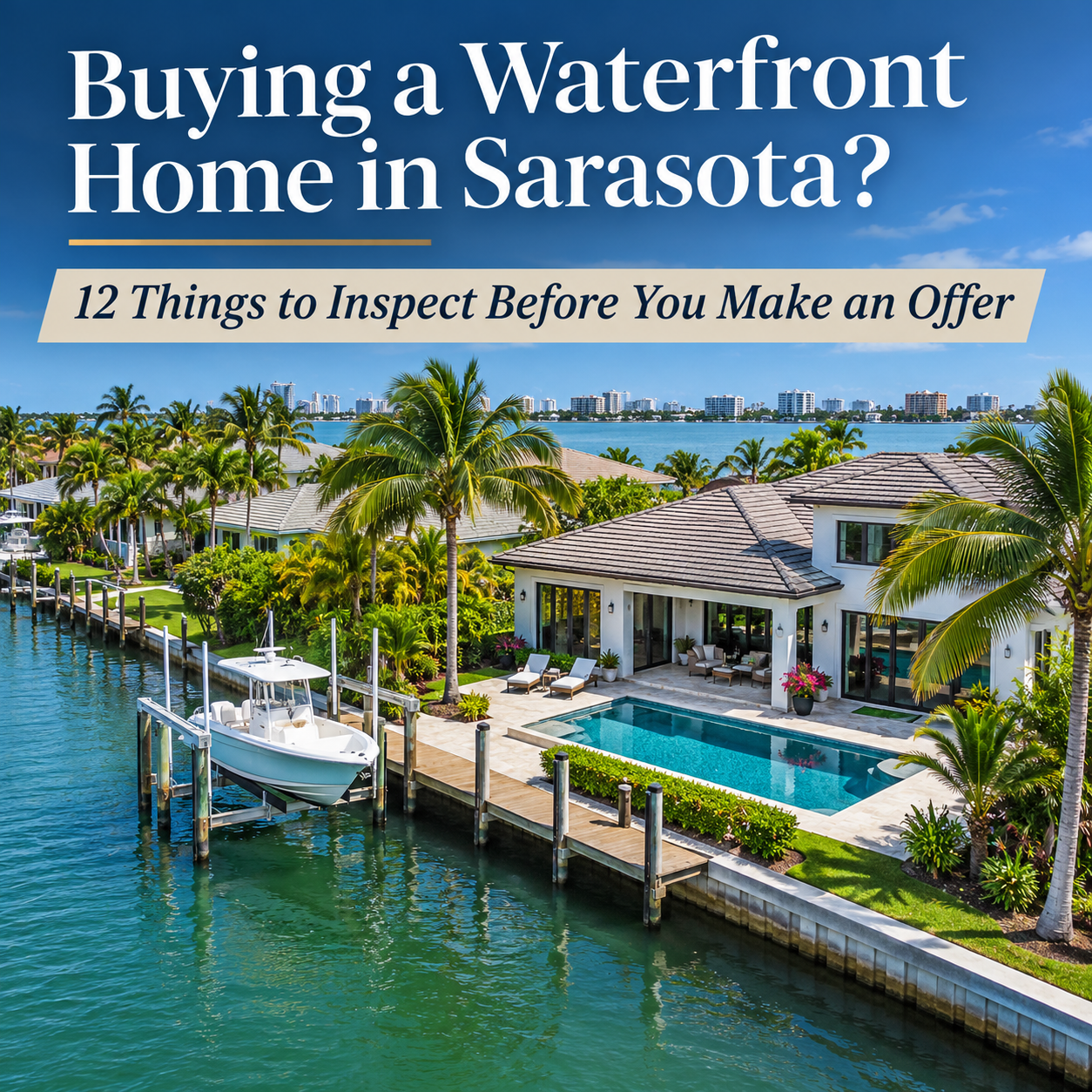
Buying a Waterfront Home in Sarasota? 12 Things to Inspect Before You Make an Offer
Seawall condition, boat lifts, water depth, bridge clearances, flood elevation, permits, and insurance quotes: the twelve checks that separate a waterfront bargain from a waterfront money pit.
Buying a Waterfront Home in Sarasota? 12 Things to Inspect Before You Make an Offer
By Kelly Fullick | Sarasota & Manatee County Realtor
There's something special about walking into a waterfront home in Sarasota. Maybe it's the view across the bay, the boat sitting behind the house, or the idea of stepping outside and being on the water within minutes.
But before you fall in love with the view, there's something important to understand.
Buying waterfront real estate in Sarasota involves considerations that don't exist with most inland properties.
Two waterfront homes can look remarkably similar, yet one may accommodate your boat, have a seawall in excellent condition, and offer relatively straightforward insurance options. The other may have costly shoreline repairs ahead, limited navigability, or restrictions that prevent you from using the waterfront the way you imagined.
As a Sarasota Realtor, I believe understanding those differences is essential before deciding what a property is worth to you.
Here are 12 things I encourage waterfront buyers to investigate before making an offer, or to address through appropriate inspections and contract contingencies.
1. Start With the Seawall
A seawall may be one of the most important structural components of a waterfront property, and one of the easiest to overlook during a showing.
Seawalls help stabilize shorelines and protect the land behind them from erosion.
Look for visible warning signs such as:
- Cracks, separation, or leaning sections
- Soil settlement behind the wall
- Depressions or sinkholes near the shoreline
- Rust staining or deteriorating concrete
- Water escaping through joints or openings
- Evidence of previous patchwork repairs
Not every crack indicates structural failure, but visible deterioration deserves professional evaluation.
My recommendation: When purchasing a property with a seawall, consider hiring a qualified marine contractor or coastal engineer to evaluate its condition, rather than assuming a general home inspection covers it.
A beautiful home with an aging seawall may still be a worthwhile purchase. The important question is whether the price appropriately reflects the condition and potential future expenses.
2. Inspect the Dock and Boat Lift
A dock is not automatically an asset simply because it exists.
Wooden decking, pilings, fasteners, electrical systems, and boat lift components are continually exposed to moisture and, in saltwater environments, corrosion.
Before purchasing, determine:
- When was the dock constructed or last renovated?
- Are the pilings and structural supports sound?
- What is the boat lift's rated capacity?
- Does the lift accommodate your vessel's dimensions?
- Are electrical components properly installed and maintained?
- Is the dock legally permitted?
- Have previous repairs or additions been documented?
A boat lift designed for a smaller center-console boat may not accommodate the vessel you intend to purchase.
And a dock that physically exists is not necessarily one that can legally be expanded or replaced in the same configuration.
3. Confirm the Actual Water Depth
One of the biggest mistakes a waterfront buyer can make is assuming that visible water means usable boating access.
Water depth changes with tides, weather conditions, sediment movement, and the configuration of the canal or bay.
A property may have sufficient depth near the dock but become difficult to navigate farther along the canal.
If you own a boat, investigate the depth at the dock, along the route, and at potential shallow points.
Your vessel's draft matters, but so does the clearance needed beneath the hull and propulsion equipment.
A home with Gulf access is not necessarily a home with suitable Gulf access for your boat.
For a more detailed explanation, read my guide: Sailboat Water vs. Powerboat Water in Sarasota.
4. Identify Every Bridge Between Your Dock and Open Water
Sarasota's waterways offer very different boating experiences depending on where a property is located.
Some waterfront properties provide routes to open water without passing beneath fixed bridges. Others require navigating under bridges that limit vessel height.
Before buying, establish:
- Whether fixed bridges exist along your intended route
- Published bridge clearances and the applicable water-level reference
- Whether drawbridges operate along the route
- Your vessel's air draft, including antennas and equipment
- How tidal conditions affect usable clearance
Don't rely solely on a listing description that says "sailboat water" or "Gulf access."
Those descriptions are useful starting points, but they don't replace verifying the actual navigation route.
5. Investigate Flood Zones and Elevation
Flood exposure is one of the most important financial considerations when purchasing waterfront property.
Sarasota County includes properties within FEMA flood zones such as AE, VE, and X.
These classifications affect how flood hazards are mapped, and they may influence insurance requirements, construction rules, and financing.
However, two properties within the same flood zone can have substantially different characteristics.
Consider the home's:
- Finished-floor elevation
- Elevation certificate, if available
- Construction type and age
- Flood openings and enclosed areas below elevated floors
- Previous flood damage and repairs
- Applicable local floodplain requirements
A property's flood zone does not tell the entire story.
For example, a home with a higher finished-floor elevation may present different exposure than a lower-elevation home in the same general neighborhood.
Sarasota County's updated flood maps became effective March 27, 2024. Buyers should check the current maps rather than relying on older listing information.
6. Obtain Insurance Quotes Before Committing
Waterfront ownership costs extend well beyond property taxes and a mortgage payment.
Depending on the property, buyers may need to consider homeowners insurance, windstorm coverage, flood insurance, and other coverage specific to their circumstances.
Insurance premiums can vary significantly based on construction, roof characteristics, elevation, prior claims, coverage limits, and insurer underwriting.
A home that appears affordable based on its purchase price may carry substantially higher annual ownership expenses than anticipated.
My recommendation: Request property-specific insurance quotes early in the purchase process, ideally before finalizing an offer.
Do not assume the seller's current premium will be available to a new owner.
7. Verify Dock Permits and Waterfront Improvements
One of the most important questions isn't whether a waterfront improvement exists.
It's whether that improvement was properly authorized.
Docks, boat lifts, seawalls, and other shoreline structures may involve multiple permitting authorities.
Depending on the location and project, these can include local building departments, the Florida Department of Environmental Protection, and federal agencies.
Some projects qualify for exemptions, but an exemption from one agency does not automatically eliminate other approval requirements.
Request documentation for existing structures and improvements, especially if you notice additions that appear newer than the original construction.
Also investigate whether unresolved code violations or permit issues exist.
8. Understand Riparian Rights and Submerged Land Ownership
Waterfront ownership does not always mean you own the land beneath the adjacent water.
In Florida, riparian or littoral rights can involve access to navigable water and other legally recognized uses associated with qualifying waterfront property.
However, these rights are subject to legal limitations, regulatory restrictions, and the particular circumstances of the property.
State-owned submerged lands may require separate authorization for certain structures and activities.
Before assuming you can build a larger dock, install additional lifts, or modify the shoreline, investigate the applicable property rights and permitting requirements.
A real estate attorney experienced in Florida waterfront matters can help evaluate complex title, boundary, and water-access questions.
9. Look Beyond the View to the Shoreline Orientation
Not all waterfront views offer the same living experience.
Consider whether the home faces east, west, north, or south, and how that orientation affects daily life.
A western exposure may provide beautiful sunset views but can also mean substantial afternoon sun on outdoor living areas.
An eastern exposure may offer cooler late-afternoon conditions and sunrise views.
Also evaluate:
- Privacy from neighboring properties
- Boat traffic and wakes
- Exposure to prevailing winds
- Open-water conditions
- Sunlight on the pool and lanai
- Nearby waterfront development
These characteristics may influence both your enjoyment of the home and its future appeal to buyers.
10. Evaluate Saltwater Exposure and Maintenance
Coastal living is beautiful, but salt air and moisture can accelerate deterioration of certain materials.
Pay attention to exterior hardware, metal railings, lighting fixtures, air-conditioning equipment, fasteners, and exposed mechanical systems.
Ask about maintenance schedules and previous replacements.
A waterfront property may benefit from more frequent inspections, cleaning, protective coatings, and equipment servicing.
The closer a home is to saltwater exposure, the more important material selection and preventative maintenance may become.
11. Research the Neighborhood's Waterfront Restrictions
Even if a property has a dock and suitable water depth, neighborhood rules may affect how you use it.
Some waterfront communities have HOA or deed restrictions governing vessel storage, dock modifications, lifts, waterfront construction, or other activities.
Restrictions vary by community and sometimes by individual parcel.
Review governing documents rather than relying on verbal assumptions.
This is especially important if you intend to purchase a larger boat, renovate an existing dock, add a lift, or make major exterior improvements.
12. Determine Whether the Waterfront Features Support the Asking Price
This is where waterfront real estate becomes particularly interesting.
Imagine two Sarasota homes with similar interior square footage, comparable finishes, and similar lot sizes.
One offers a protected canal with a functioning dock and direct access suitable for the buyer's vessel.
The other has a broader water view but limited boating capability and a seawall requiring significant attention.
Which is more valuable?
The answer depends on the market, the property's characteristics, and what buyers are willing to pay for those differences.
Waterfront valuations should consider factors such as:
- Water frontage and lot configuration
- Navigability and access to open water
- View quality and privacy
- Dock and seawall condition
- Home elevation and construction quality
- Location and neighborhood desirability
- Recent comparable waterfront sales
A property may command a premium for a spectacular view, while another attracts buyers who prioritize immediate boating access.
The challenge is identifying which characteristics the market has actually rewarded.
That's why I believe waterfront properties deserve a more detailed comparative market analysis than simply calculating a neighborhood's average price per square foot.
The Waterfront Buying Checklist
Before moving forward with a Sarasota waterfront property, make sure you've investigated these questions:
- Has the seawall been evaluated?
- Are the dock and boat lift in acceptable condition?
- Is the water depth appropriate for your vessel?
- Have bridge clearances and navigation routes been verified?
- Have you reviewed flood maps and elevation information?
- Have you obtained property-specific insurance quotes?
- Have dock and shoreline permits been reviewed?
- Are waterfront rights and submerged land issues understood?
- Does the property's orientation suit your lifestyle?
- Have saltwater-related maintenance concerns been evaluated?
- Have applicable neighborhood restrictions been reviewed?
- Does the asking price reflect the property's actual waterfront advantages and limitations?
Frequently Asked Questions About Buying Sarasota Waterfront Property
Q: Is every Sarasota waterfront home suitable for boating?
A: No. Some waterfront properties have shallow water, bridge restrictions, limited navigation routes, or other conditions that make them unsuitable for particular vessels.
Q: Should I get a separate seawall inspection?
A: A specialist evaluation is worth considering, especially when the seawall's age, condition, or maintenance history is uncertain. General home inspections may not provide the technical assessment needed.
Q: Does buying a waterfront home automatically give me the right to build a dock?
A: No. Dock construction may depend on property rights, waterway conditions, environmental protections, setbacks, and required government authorizations.
Q: Are waterfront homes always in high-risk flood zones?
A: No. Flood classifications vary by property, and waterfront proximity alone does not establish a home's official FEMA flood zone.
Q: Are waterfront homes more expensive to maintain?
A: They can be. Saltwater exposure, marine structures, specialized equipment, and insurance needs can create additional ownership expenses.
Buying Waterfront Property in Sarasota Starts With Asking Better Questions
A waterfront home can offer an extraordinary lifestyle, whether you envision boating on Sarasota Bay, enjoying sunsets over the water, or spending quiet mornings overlooking a peaceful canal.
But the most successful purchase isn't necessarily the property with the most impressive view.
It's the property that offers the lifestyle you want, with conditions, limitations, and ownership costs you understand.
I'm Kelly Fullick, a Sarasota Realtor serving Sarasota and Manatee counties.
If you're considering buying or selling waterfront property, I'd welcome the opportunity to help you evaluate the features that make each waterfront home unique. You can also browse Sarasota waterfront homes currently on the market, or read my overview of bayfront, canal, and Gulf-access homes in Sarasota.
Kelly Fullick | Sarasota Real Estate
941.260.7770
Kelly@KellyFullick.com
www.KellyFullick.com
This article provides general real estate education. Property-specific marine, structural, insurance, permitting, and legal questions should be evaluated by appropriately qualified professionals.
About Kelly Fullick
Kelly Fullick is a Sarasota-native Realtor with Coldwell Banker Realty. She specializes in helping out-of-state relocation buyers and Sarasota-area sellers with candid, education-first guidance. Kelly has closed 36+ transactions totaling over $18.6M across Sarasota and Manatee County since 2022, and holds a perfect 5.0-star rating on 25 Google reviews.

Ready to take the next step?
Let's Talk About Your Goals
Every situation is different. Schedule a no-pressure conversation with Kelly to get clear on your options.
941.260.7770
kelly@kellyfullick.com
Schedule a Consultation