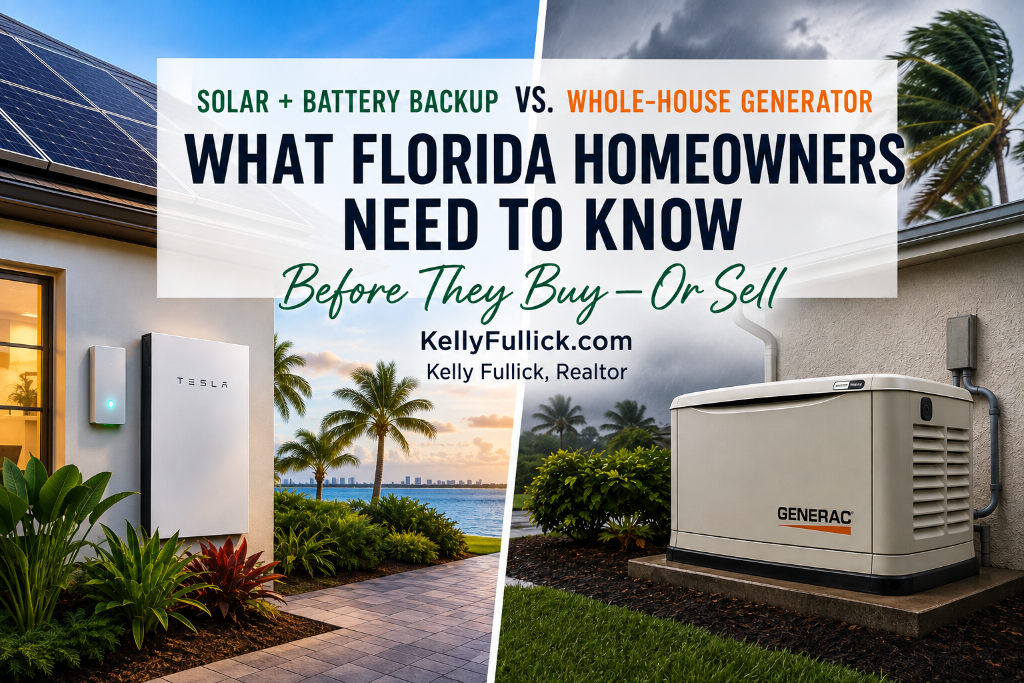
Solar + Battery Backup vs. Whole-House Generator: What Florida Homeowners Need to Know Before They Buy — Or Sell
If you want the cheapest, most reliable backup power for hurricane season, a whole-house natural gas generator wins in 2026. If you want long-term energy independence and lower electric bills, solar + battery still wins — but only if you buy it the right way. And how you paid for solar can quietly wreck your home sale.
Solar + Battery Backup vs. Whole-House Generator: What Florida Homeowners Need to Know Before They Buy — Or Sell
Sarasota Homeowner Series · Kelly Fullick, Sarasota Native Realtor
The One-Line Answer
If you want the cheapest, most reliable backup power for hurricane season, a whole-house natural gas generator wins in 2026 — full stop. If you want long-term energy independence and lower electric bills, solar + battery still wins — but only if you buy the system with cash or a proper home-equity loan, not a solar loan.
And here's the part most Florida homeowners don't realize until they're 45 days from closing: how you paid for solar can quietly wreck your home sale. A whole-house generator, by contrast, is treated the same way as a hot water heater — it just adds value and moves with the house.
Let me walk you through the real numbers, the resale reality, and what I'm seeing in Sarasota and Manatee County listings this year.
What Each System Actually Does
Whole-house standby generator: A permanently installed unit (typically Generac, Kohler, Cummins, or Briggs & Stratton) that sits on a concrete pad outside your home. It's wired into your electrical panel through an automatic transfer switch. When power goes out, it starts within 10–30 seconds and runs your entire home on natural gas or propane. It runs as long as you have fuel.
Solar + battery backup: Rooftop solar panels generate electricity during the day. A battery system (typically Tesla Powerwall 3, Enphase IQ Battery, or FranklinWH) stores excess energy. During a grid outage, the battery powers critical circuits (or your whole home, depending on size) and the panels can keep recharging the battery each day the sun is out.
Two very different tools. Both keep the lights on. Only one is designed to also lower your electric bill.
The 2026 Cost Reality — Florida Numbers
Whole-House Generator
Based on 2026 Florida installer data:
| Home Size | Total Installed Cost |
|---|---|
| Small (under 1,500 sq ft) | $12,500 – $16,000 |
| Medium (1,500 – 2,500 sq ft) | $16,500 – $20,000 |
| Large (2,500+ sq ft) | $20,500 – $25,000+ |
What's included: 15kW–22kW generator unit, automatic transfer switch, fuel line hookup, concrete pad, permits, inspection, labor.
Ongoing costs: Natural gas bill during outages (typically $30–80 per day of use), annual maintenance ($200–$400), fuel filter changes.
Solar + Battery Backup
A typical Sarasota home installation in 2026:
| Component | Cost |
|---|---|
| 10–12 kW solar array (25–30 panels) | $25,000 – $35,000 |
| 2 Tesla Powerwall 3 batteries (27 kWh) | $17,000 – $22,000 |
| Inverter, wiring, roof mounts, permits, labor | $6,000 – $10,000 |
| Total installed cost | $48,000 – $67,000 |
Ongoing costs: Effectively $0. Panels have 25-year warranties. Batteries typically warrantied for 10 years or ~5,000 cycles.
The 2026 Curveball Most Solar Installers Won't Volunteer
The 30% federal solar tax credit expired December 31, 2025. Under the One Big Beautiful Budget Act, any residential solar system placed in service in 2026 or later does NOT qualify for the federal credit. That was often $15,000–$20,000 back to the homeowner. It's gone.
Florida still offers:
- 100% property tax exclusion on the added value from solar
- Full state sales tax exemption on solar equipment
- Net metering with your utility (FPL, Duke Energy Florida, TECO, etc.) — excess kWh roll forward as bill credits for up to 12 months
But losing the 30% federal credit changed the math significantly. A system that penciled out at $40,000 in 2025 is genuinely $48,000+ in 2026.
The Hurricane-Reliability Comparison
Living in Sarasota, this is what actually matters.
Generator Wins When…
- You lose power for 3+ days. This is the killer scenario for solar + battery. A single Powerwall stores ~13.5 kWh. The average Florida home uses 32 kWh/day. Even with two batteries and full sun the next day, if you're running AC, a well pump, and a fridge, you may not fully recharge.
- A storm rolls through and blocks the sun for 2–4 days. Solar generation drops 60–90% during heavy overcast. Batteries drain. Generator doesn't care — it runs off your gas line.
- You need to run everything. A 22kW generator can run your AC, oven, well pump, pool pump, and hot water heater simultaneously. Battery systems typically require you to prioritize circuits (fridge + fans + lights + one AC unit — not everything at once).
Solar + Battery Wins When…
- Grid outages are frequent but short. Powerwalls are online in milliseconds, silent, and produce no fumes. Great for the 4–20 hour outages that happen more often than the big hurricane events.
- Fuel supply becomes an issue. After a major hurricane, natural gas service can go down. Propane deliveries get delayed 1–3 weeks. Batteries recharge from sunlight and the grid — no fuel truck needed.
- You want to save money 365 days a year. This is the real win. A generator sits there costing you money in maintenance. A solar + battery system quietly cuts your electric bill by 60–95% every month whether there's a storm or not.
The honest truth for Florida: For a serious hurricane (Category 3+, extended outage), a natural gas whole-house generator is more reliable than any residential solar + battery system on the market in 2026. Sun doesn't shine through hurricane rain bands. Batteries drain. Gas lines almost always stay pressurized.
The Resale Angle — Where This Gets Interesting
Here's where I have to be direct with you as your Realtor: generators and solar do NOT resell the same way.
Whole-House Generators at Resale
A permanently installed standby generator typically adds 3–5% to home value based on multiple 2026 industry appraisal surveys. On a $600,000 Sarasota home, that's $18,000–$30,000 in added value — often exceeding what you paid for the system.
Why generators sell so cleanly:
- Appraisers treat them as a permanent fixture (same category as HVAC)
- Buyers understand them instantly — "it's a generator, it runs the house"
- Transfer is simple: it's part of the house, it stays
- Home inspectors have a standard checklist for testing them
- Insurance companies often give a small discount for having one
- No monthly fee, no lease, no lien
What buyers ask me about generators:
- What size (kW)?
- What fuel source (natural gas is preferred over propane)?
- How old is it and when was it last serviced?
- Is there a transferable warranty?
That's it. Easy conversation.
Solar Panels at Resale — The Long Version
This is where it gets complicated fast. How the solar was paid for matters more than the panels themselves.
Scenario 1: Owned outright (cash purchase or home equity loan)
- Adds value at resale — studies from Zillow historically show ~4% increase, though the 2026 market is still absorbing the loss of the federal tax credit
- No liens, no leases, no third-party involvement
- Transfers cleanly at closing like any other home improvement
- My take: This is the ONLY solar setup that adds unambiguous value to a Sarasota home. If a seller has cash-owned solar, I list it as a genuine premium feature.
Scenario 2: Solar loan (financed through the installer or a third-party finance company like Sunlight Financial, GoodLeap, Mosaic, Dividend Finance)
- The lender often files a UCC-1 fixture filing against the property, which shows up in the title search
- The loan is separate from your mortgage — buyer either has to assume the loan (rare, usually requires the buyer to qualify with the solar lender) or the seller has to pay it off at closing (often $20,000–$40,000 out of pocket)
- If the seller can't pay off the balance, the deal can fall apart
- My take: I have to have a specific conversation with any Sarasota homeowner using solar loans about how they'll unwind that loan before listing. It has killed deals in this market. It's not rare.
Scenario 3: Solar lease or Power Purchase Agreement (PPA) — Sunrun, SunPower, Tesla Energy, Palmetto, etc.
- The panels are owned by the solar company, not you
- Buyer has to either assume the lease (subject to credit check and often 15–20 more years of payments) OR seller has to buy out the lease at closing (typically $15,000–$30,000)
- FHA and VA loans have specific rules about solar leases that can complicate buyer financing
- Some appraisers assign ZERO value to leased solar because the homeowner doesn't own it
- My take: Leased solar is the hardest solar scenario to sell in the Sarasota market. I've watched multiple sellers give buyers a $10,000–$20,000 credit at closing just to keep deals together.
Scenario 4: PACE financing (Property Assessed Clean Energy)
- The solar cost is added to your property tax bill as a non-ad valorem assessment
- The assessment is technically senior to your mortgage in Florida — meaning it has to be paid off at closing
- Freddie Mac and Fannie Mae won't back mortgages on homes with active PACE liens
- My take: PACE-financed solar creates serious refinancing and resale problems. Most Sarasota buyers using conventional financing can't close on a home with an active PACE lien. It has to be paid off first.
The Realtor's Blunt Assessment
If you're thinking about installing solar because you plan to sell in the next 5 years: pay cash or use a home equity loan. Never use a solar loan, lease, or PACE assessment.
If you're planning to live in the home for 20+ years: solar makes financial sense even after losing the federal credit, especially with a Powerwall for backup. Just understand the math is very different than it was in 2024.
If your primary goal is hurricane preparedness: get the generator. Full stop. Cheaper, more reliable in extended outages, and it clearly adds value at resale.
What Buyers Are Actually Willing To Pay Extra For — Sarasota Market Reality
From what I'm seeing on Sarasota and Manatee County listings in 2026:
Buyers happily pay a premium for:
- Whole-house natural gas generator — routinely called out in listing highlights, especially in Palmer Ranch, Lakewood Ranch, and Longboat Key
- Owned solar panels (paid off, transferrable warranty) — treated as a genuine plus, especially on newer construction
- Hurricane shutters + generator combo — this is a top-tier selling combo in flood-prone areas
Buyers get nervous about:
- Leased solar — direct questions like "how do I get out of this?" and "what does it cost to buy out?"
- Solar loans with UCC-1 filings — title company calls me the day before closing to say "we found a UCC-1"
- PACE-financed anything — often becomes a deal-breaker for conventional buyers
Buyers don't care about:
- Portable generators (not a fixture, they take it with them anyway)
- Solar water heaters (nice, but not a difference-maker)
- Small battery-only systems (under 10 kWh) without solar
My Recommendation for Most Sarasota Homeowners
If you're worried about hurricane outages and plan to sell within 10 years:
- Whole-house natural gas generator ($15,000–$22,000 for a typical Sarasota home)
- Clear resale value, clear buyer story, simple maintenance
If you're a "forever home" owner who wants energy independence and lower bills:
- Solar + battery — but ONLY if you can pay cash or use a proper home equity loan
- Budget $50,000–$65,000 for a system that will meaningfully cover a typical home
- Do the math on your specific electric bill — solar pencils out best for homes with $250+/month electric bills
If you want both (hurricane reliability AND long-term savings):
- Add solar + battery to a home that already has (or is getting) a generator
- The generator is your hurricane insurance; the solar is your monthly bill reducer
- This is the setup I'm seeing on high-end Longboat Key and Bird Key homes
Questions to Ask Any Contractor Before You Sign
For a generator installer:
- What's the total installed cost including permit, transfer switch, and gas line hookup?
- Is this generator size (in kW) large enough to run my entire home, or only critical circuits?
- What's the manufacturer warranty and is it transferrable to future owners?
- What's the annual maintenance plan and cost?
- Can I see recent Sarasota/Manatee installations you've done?
For a solar installer:
- Is this a cash purchase, loan, lease, or PPA? Get it in writing.
- If a loan: will there be a UCC-1 filing against my property? (If yes — walk away or negotiate)
- If a lease/PPA: what's the buyout schedule year by year?
- What warranty covers the panels? The inverter? The battery? What happens to warranties if I sell?
- What's the estimated payback period based on MY actual electric bill?
- What are the escalator clauses (rate increases) if this is a lease/PPA?
The Bottom Line
- Generators are simpler, cheaper, more hurricane-reliable, and always add resale value. For most Sarasota homeowners this is the right call.
- Solar + battery is a long-term financial play that only works if you own it outright and stay in the home long enough to recoup the cost.
- How you PAY for solar matters more than whether you HAVE solar when it comes to selling your Sarasota home.
If you're planning any home improvement worth $15,000+ and you might sell within 10 years, please talk to a Realtor before you sign. I've watched too many Sarasota sellers get blindsided at closing by financing they didn't fully understand when they installed it.
Happy to walk any of this through with you specifically — every home is different, and the right answer really does depend on how long you plan to stay, how you'd finance it, and what your electric bill actually looks like.
Kelly Fullick Sarasota Native Realtor · Coldwell Banker Realty kellyfullick.com · 941-260-7770
This is general education, not financial or tax advice. Consult a licensed installer, your utility, a Florida-licensed contractor, and a CPA before making decisions about solar, generators, or financing. Costs and incentives cited reflect publicly available data as of mid-2026 and may change.
About Kelly Fullick
Kelly Fullick is a Sarasota-native Realtor with Coldwell Banker Realty. She specializes in helping out-of-state relocation buyers and Sarasota-area sellers with candid, education-first guidance. Kelly has closed 36+ transactions totaling over $18.6M across Sarasota and Manatee County since 2022, and holds a perfect 5.0-star rating on 25 Google reviews.

Ready to take the next step?
Let's Talk About Your Goals
Every situation is different. Schedule a no-pressure conversation with Kelly to get clear on your options.
941.260.7770
kelly@kellyfullick.com
Schedule a ConsultationMore from the Journal

Money Mechanics
Money Mechanics 8 — 1031 Exchanges for Sarasota Investors: The Rules, the Timelines & Where People Actually Trip Up

Money Mechanics
Meet Trevor: The Guy in Manhattan Who's Quietly Deciding What Your House Costs

Money Mechanics