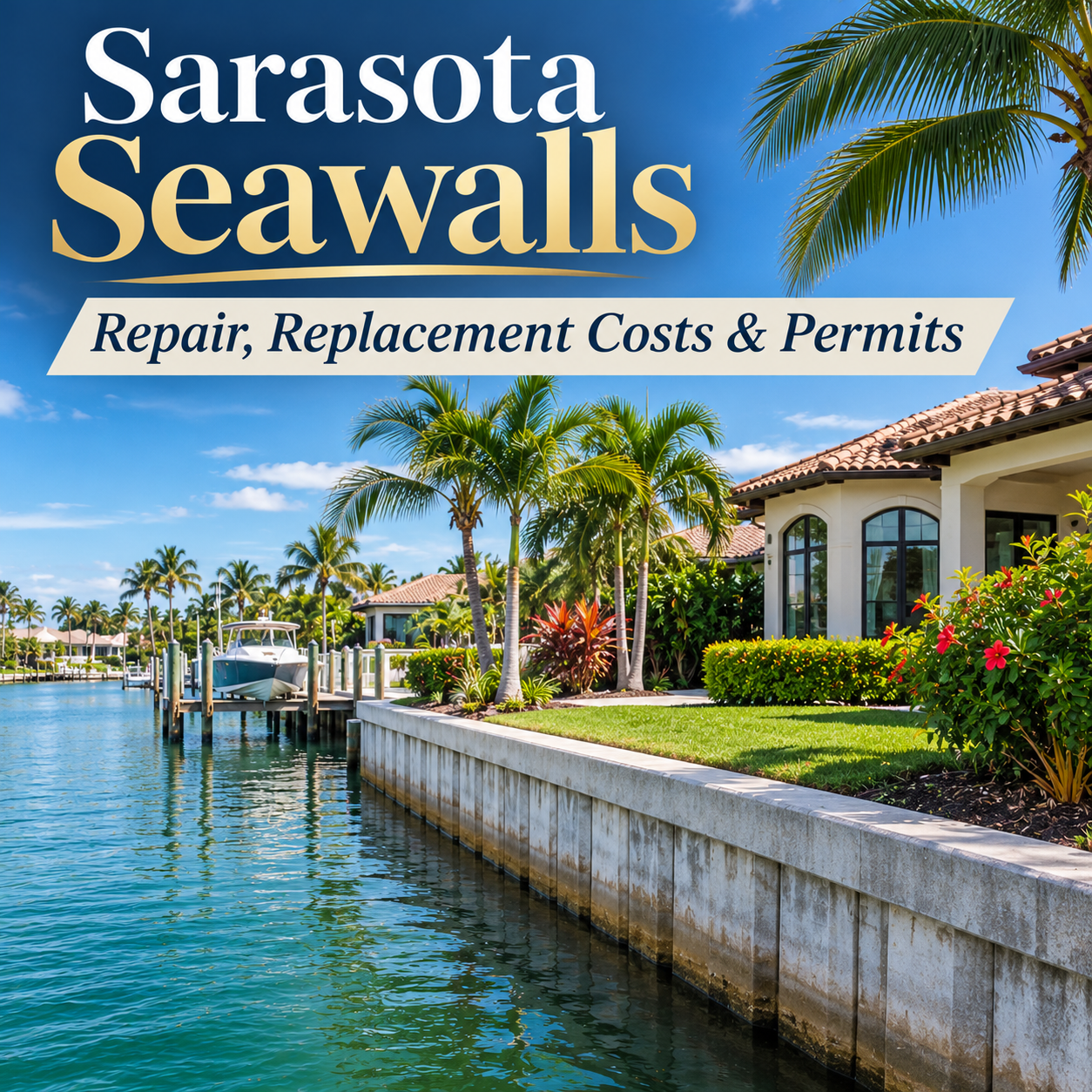
Sarasota Seawalls: Repair, Replacement Costs, Permits, and What Waterfront Buyers Need to Know
What a Sarasota seawall actually does, the seven warning signs of failure, published cost ranges per linear foot, permitting realities, and how seawall condition affects waterfront value.
Sarasota Seawalls: Repair, Replacement Costs, Permits, and What Waterfront Buyers Need to Know
By Kelly Fullick | Sarasota & Manatee County Realtor
Imagine finding a beautiful waterfront home in Sarasota. The pool overlooks a peaceful canal, there's a private dock waiting for your boat, and the landscaping is everything you'd expect from coastal Florida living.
But there's one feature that deserves just as much attention as the home itself.
The seawall.
A seawall might not be the most exciting part of a waterfront property, but its condition can have a significant impact on your investment. Depending on its age, construction, and structural integrity, it could represent years of relatively routine maintenance or a major expense you weren't expecting.
Whether you're buying waterfront property on Siesta Key, Longboat Key, Bird Key, or along Sarasota's many residential canals, understanding seawalls is an important part of making an informed real estate decision.
Let's explore what seawalls do, how to recognize potential problems, what repairs and replacements may cost, and why these structures matter when buying or selling Sarasota waterfront real estate.
What Is a Seawall, and Why Does It Matter?
A seawall is a shoreline stabilization structure designed to retain soil and help protect waterfront land against erosion and water-related forces.
In Sarasota, seawalls are common along residential canals, portions of Sarasota Bay, and other developed waterfront areas.
While the visible wall may appear relatively simple, many seawall systems include several important structural components.
Seawall panels: Vertical sections, often constructed from concrete, vinyl, steel, or other engineered materials, that retain the soil behind the shoreline.
Seawall cap: The horizontal structural component connecting the tops of the wall panels.
Tiebacks and anchors: Components that help resist pressure from the retained soil and stabilize the wall.
Drainage systems: Features intended to manage water pressure behind the wall.
When these systems begin to deteriorate, the effects may extend beyond the shoreline itself.
Soil movement, settlement, and erosion can affect landscaping, patios, walkways, and nearby improvements.
For waterfront buyers, the seawall should be considered part of the property's overall structural and financial picture.
7 Warning Signs a Sarasota Seawall May Need Repair
Not every aging seawall requires replacement. However, there are several conditions buyers and homeowners should recognize.
1. Cracks in the concrete
Small surface cracks may be relatively minor, while larger or expanding cracks can indicate more significant structural movement or deterioration.
A qualified professional should determine the cause rather than relying on appearance alone.
2. Leaning or bowing
A seawall that visibly leans toward the water or bows between supports may be experiencing excessive pressure or structural problems.
This deserves prompt professional evaluation.
3. Soil settlement behind the wall
One of the more concerning signs is sinking or depressed soil along the landward side of a seawall.
This can occur when soil migrates through openings or beneath portions of the structure.
4. Separation between panels
Gaps between seawall panels can allow soil loss and may indicate movement or deteriorating connections.
5. Rust staining and exposed reinforcement
Rust stains, spalling concrete, and exposed steel reinforcement may indicate corrosion-related deterioration.
6. Deteriorating seawall caps
Cracking, displacement, or separation of the cap can indicate problems with the wall system.
7. Previous repairs without documentation
A repaired seawall isn't necessarily a problem.
However, buyers should ask what work was completed, who performed it, whether engineering was involved, and whether applicable permits were obtained.
My advice: Never assume a seawall is structurally sound simply because the landscaping around it looks beautiful.
How Much Does Seawall Replacement Cost in Sarasota?
This is one of the most common questions waterfront buyers ask, and one of the hardest to answer accurately without evaluating the property.
Seawall costs depend on the type of wall, its length, water depth, site accessibility, engineering requirements, and the scope of work.
Published Sarasota and Southwest Florida estimates vary considerably.
For general budgeting, regional sources have published the following approximate ranges:
| Project type | Published estimated cost |
|---|---|
| Vinyl seawall replacement | $400 to $900 per linear foot |
| Concrete seawall replacement | $650 to $1,200 per linear foot |
| Seawall cap repairs | $150 to $400 per linear foot |
| Soil void filling and stabilization | $3,000 to $15,000 for some projects |
These are broad published estimates, not verified contractor bids for a particular Sarasota property. Some projects fall outside these ranges, and engineering, permitting, access, demolition, and restoration may add substantial costs.
What would a 100-foot seawall cost?
Using an illustrative replacement range of $500 to $1,200 per linear foot:
- 75 linear feet: $37,500 to $90,000
- 100 linear feet: $50,000 to $120,000
- 150 linear feet: $75,000 to $180,000
These calculations illustrate the effect of wall length. They are not complete project estimates or a substitute for a site-specific proposal.
A seawall requiring extensive demolition, difficult equipment access, specialized engineering, or substantial site restoration could cost more.
This is exactly why waterfront buyers should investigate seawall conditions before determining what they're comfortable paying for a property.
Repair or Replace? Understanding the Difference
A seawall showing signs of deterioration does not automatically require complete replacement.
In some situations, targeted repairs may be appropriate.
These might include:
- Repairing sections of the seawall cap
- Addressing localized cracks
- Replacing damaged panels
- Repairing or strengthening anchoring systems
- Stabilizing soil voids behind the wall
- Improving drainage where appropriate
However, extensive structural deterioration may make replacement the more practical long-term solution.
The decision should come from a qualified marine contractor or engineer after evaluating the actual condition of the wall.
A lower-cost repair is not necessarily a better investment if it fails to address the underlying structural problem.
How Long Does a Seawall Last in Florida?
There's no universal expiration date for a seawall.
Its service life depends on several factors, including construction materials, engineering, installation quality, environmental exposure, maintenance, and storm damage.
A properly designed and maintained seawall may perform for decades, while a newer wall with construction defects or unfavorable site conditions may develop problems much earlier.
Saltwater exposure, wave action, boat wakes, corrosion, and soil conditions can all affect performance.
Rather than asking only how old a seawall is, I encourage buyers to ask:
What is its current condition, what maintenance has been completed, and what remaining service life does a qualified professional anticipate?
Those answers are more useful than relying on age alone.
Do You Need a Permit to Repair or Replace a Seawall in Sarasota?
Potentially, yes.
Seawall construction and repairs may involve several regulatory authorities depending on the property's location and the proposed work.
These can include local governments, the Florida Department of Environmental Protection, and the U.S. Army Corps of Engineers.
Florida law provides exemptions for certain seawall construction, repair, and restoration activities that meet specific conditions.
However, qualifying for an exemption from one permit requirement does not necessarily eliminate other approvals or authorizations.
For example, work involving state-owned submerged lands can raise additional considerations.
Properties located near protected habitats, coastal construction control lines, or environmentally sensitive areas may face different requirements.
Before hiring a contractor, confirm:
- Which governmental jurisdiction applies to the property?
- What permits or exemptions apply to the proposed work?
- Is professional engineering required?
- Are environmental authorizations necessary?
- Are there restrictions on moving or extending the seawall?
- Are final inspections or completion documents required?
A contractor experienced with Sarasota waterfront construction should be familiar with the applicable review process.
Can You Move a Seawall Farther Into the Water?
This is an especially important question for buyers considering waterfront renovations.
You generally cannot assume that you may move a seawall farther waterward simply because you own the adjoining property.
Shoreline alterations can affect navigation, aquatic habitat, submerged lands, neighboring properties, and public resources.
Some narrowly defined restoration activities may qualify for specific regulatory exemptions, but those provisions have detailed conditions.
Moving a seawall or reclaiming additional land may require approvals that are difficult or impossible to obtain for a particular project.
If your plans involve changing the shoreline configuration, investigate feasibility before purchasing.
Do Seawalls Affect Waterfront Property Values?
Absolutely, although not always in the way homeowners expect.
A seawall in good condition can reduce uncertainty for prospective buyers.
A deteriorating seawall may introduce future expenses, construction complications, and negotiation concerns.
But there's an important distinction between the cost of a seawall improvement and the amount that improvement contributes to market value.
For example, suppose a waterfront seller recently spent $100,000 replacing a seawall.
That expenditure does not automatically mean the home is worth $100,000 more than an otherwise comparable property.
The improvement may protect existing value, reduce buyer objections, and make the home more marketable.
Conversely, a property with a failing seawall may sell at a discount that reflects more than the estimated repair cost because buyers also consider inconvenience, risk, timing, and uncertainty.
An appropriate valuation should consider recent comparable waterfront sales and any market evidence showing how buyers have responded to differences in seawall condition.
Buying a Waterfront Home With an Aging Seawall
Imagine two waterfront properties in the same Sarasota neighborhood.
Both have comparable homes, similar lot sizes, and desirable boating access.
One has a recently replaced seawall with supporting permits and documentation.
The other has an older seawall with visible deterioration and no recent inspection.
Would you pay the same price for both?
Probably not without understanding the difference.
However, the appropriate adjustment isn't automatically equal to the full cost of replacement.
A professional inspection, written repair proposals, the home's asking price, and comparable sales all contribute to the decision.
For the broader inspection list I walk buyers through, read my guide to 12 things to inspect before making an offer on a Sarasota waterfront home.
Questions I would want answered before making an offer
- What is the seawall's approximate age?
- Has it ever been repaired or replaced?
- Are permits and engineering records available?
- Are there signs of settlement or structural movement?
- Has a qualified professional evaluated the wall?
- What repairs are anticipated?
- Are there access or permitting challenges?
- Does the asking price already account for its condition?
The objective isn't necessarily to avoid an older seawall.
It's to understand what you're purchasing.
Selling a Sarasota Waterfront Home With an Older Seawall
If you're preparing to sell a waterfront home, you may be wondering whether to repair the seawall before listing.
The answer depends on the condition, the property's value, the anticipated repair cost, and the likely buyer pool.
In some cases, completing repairs before listing can reduce uncertainty and improve marketability.
In others, obtaining a professional evaluation and pricing the property appropriately may make more financial sense.
I would consider three approaches:
Option 1: Repair before listing. This may be appropriate when the work is manageable, clearly needed, and likely to reduce significant buyer concerns.
Option 2: Obtain professional documentation. A recent inspection or engineering assessment can provide valuable information even when repairs are not immediately necessary.
Option 3: Price according to condition. If replacement is necessary but the seller prefers not to undertake the project, the asking price can reflect the property's condition and relevant market evidence.
Florida sellers also have disclosure obligations regarding known material facts affecting residential property value that are not readily observable and are not known to the buyer.
A professional evaluation is not a substitute for appropriate disclosures.
Could a Living Shoreline Be an Alternative?
Not every waterfront property requires a traditional vertical seawall.
Depending on site conditions, wave exposure, water depth, environmental requirements, and shoreline configuration, living shoreline techniques may be worth exploring.
These approaches can incorporate native vegetation, oyster habitat, and other natural or engineered stabilization features.
Living shorelines may offer ecological benefits and can sometimes provide effective erosion control.
However, they aren't appropriate for every waterfront property.
A narrow residential canal with existing vertical seawalls and boat docks presents different considerations than a gently sloping natural shoreline.
A qualified coastal professional can help determine whether alternatives are feasible.
Sarasota Seawall FAQs
Q: How much does a new seawall cost in Sarasota?
A: Published estimates vary widely. Some Sarasota-area sources place full replacement in the broad range of $500 to $1,200 per linear foot. Actual pricing requires a contractor's assessment and should account for materials, engineering, permits, access, and site conditions.
Q: Can you sell a waterfront home with a damaged seawall?
A: Yes, but known material defects may require disclosure, and seawall condition can affect pricing, financing, buyer confidence, and negotiations.
Q: Does homeowners insurance cover seawall damage?
A: Coverage depends on the policy and the cause of damage. Many standard homeowners policies exclude certain seawall, erosion, earth movement, and flood-related losses. Buyers should obtain written clarification from their insurance professional rather than assuming coverage.
Q: Can a seawall be repaired without replacing it?
A: Sometimes. Localized damage may be repairable, while extensive structural failure can require replacement. A qualified professional should determine the appropriate approach.
Q: Who is responsible for maintaining a seawall?
A: Responsibility depends on ownership, recorded agreements, association documents, and the specific property. Buyers should confirm responsibility rather than assuming it always belongs exclusively to the waterfront homeowner.
Q: Should I have a seawall inspected before buying?
A: Yes, a specialized evaluation is worth considering when a property has a seawall, particularly if its age, construction history, or condition is uncertain.
Waterfront Real Estate Is About More Than the View
Sarasota waterfront living offers an exceptional combination of boating, natural beauty, and coastal lifestyle.
But a beautiful view is only part of the property's value.
Understanding seawalls, docks, water access, insurance, and shoreline regulations helps buyers evaluate what they're purchasing and helps sellers prepare their properties for the market.
As a Sarasota Realtor, I believe buyers deserve more than a tour of the home. They deserve the information necessary to make confident decisions about the entire property.
I'm Kelly Fullick, a Sarasota Realtor serving Sarasota and Manatee counties.
Whether you're considering a waterfront home on Bird Key, Longboat Key, Siesta Key, or one of Sarasota's canal-front neighborhoods, I'd be happy to help you evaluate your options and connect you with appropriate local professionals. You can also browse Sarasota waterfront homes currently on the market or read my guide to bayfront, canal, and Gulf-access properties.
Kelly Fullick | Sarasota Real Estate
941.260.7770
Kelly@KellyFullick.com
www.KellyFullick.com
Disclaimer: Cost figures are illustrative published estimates, not contractor quotes. Permitting, structural, insurance, and legal questions should be confirmed with appropriately licensed or qualified professionals.
About Kelly Fullick
Kelly Fullick is a Sarasota-native Realtor with Coldwell Banker Realty. She specializes in helping out-of-state relocation buyers and Sarasota-area sellers with candid, education-first guidance. Kelly has closed 36+ transactions totaling over $18.6M across Sarasota and Manatee County since 2022, and holds a perfect 5.0-star rating on 25 Google reviews.

Ready to take the next step?
Let's Talk About Your Goals
Every situation is different. Schedule a no-pressure conversation with Kelly to get clear on your options.
941.260.7770
kelly@kellyfullick.com
Schedule a Consultation