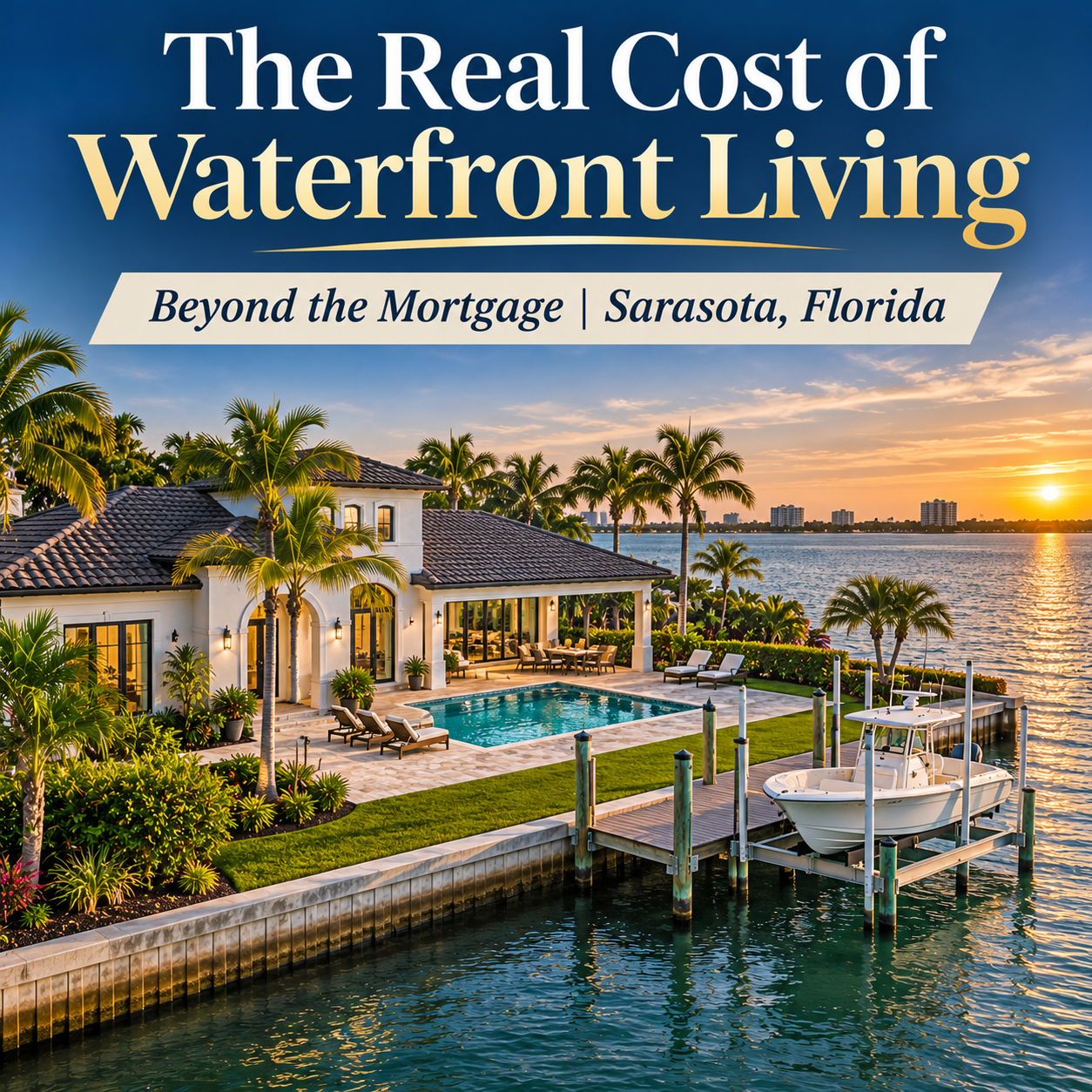
What Does It Really Cost to Own a Waterfront Home in Sarasota? Beyond the Mortgage
Taxes, wind and flood insurance, seawalls, docks, boat lifts, salt corrosion and storm prep: the twelve ownership costs that make two similarly priced Sarasota waterfront homes very different purchases.
What Does It Really Cost to Own a Waterfront Home in Sarasota? Beyond the Mortgage
Picture this: It's Saturday morning in Sarasota. You're enjoying coffee on your lanai overlooking the bay. Your boat is waiting at the dock, the palm trees are swaying, and you have absolutely no plans to sit in traffic on your way to the marina.
For many buyers, that's the dream.
But while waterfront living offers an extraordinary lifestyle, the purchase price is only one part of the financial picture.
Two Sarasota waterfront homes with the same asking price can have dramatically different ownership costs.
One may have a recently replaced seawall, a newer roof, favorable elevation characteristics, and a well-maintained dock. The other may need substantial marine repairs, carry higher insurance premiums, and have an aging boat lift.
As a Sarasota Realtor, I believe buyers should understand these differences before falling in love with a property.
Let's explore the expenses that come with waterfront homeownership in Sarasota, including some that buyers may not think to investigate until after closing.
1. Property Taxes: Don't Rely on What the Current Owner Pays
One of the most common mistakes buyers make is looking at a property's current tax bill and assuming they'll pay something similar.
In Florida, a property's taxable value may be significantly lower than its market value because of exemptions and assessment limitations.
For example, a homeowner who purchased a waterfront property many years ago may benefit from Florida's Save Our Homes assessment limitation.
When the property changes ownership, its assessed value generally resets under Florida law for the following tax year, subject to applicable rules and exemptions.
That means the seller's current property tax bill may not accurately represent what a new buyer should expect.
What about Florida's homestead exemption?
Eligible homeowners who establish a Florida property as their permanent residence may qualify for homestead benefits.
Florida also allows qualifying homeowners to transfer some of their accumulated Save Our Homes assessment benefit when moving from one homestead property to another.
This is commonly called portability.
However, eligibility, filing deadlines, and the amount of the transferable benefit depend on the homeowner's circumstances.
My recommendation: Before making an offer, use the Sarasota County Property Appraiser's tax estimator and review the assumptions with your tax professional.
The official estimator can help buyers develop a more realistic projection based on purchase price, homestead eligibility, and portability.
2. Homeowners Insurance: The House Matters as Much as the Address
It's easy to assume that every waterfront home carries unusually expensive insurance.
In reality, insurance pricing depends on numerous property-specific factors.
These may include:
- Construction year and building materials
- Roof age, shape, and condition
- Wind mitigation features
- Hurricane-rated openings and shutters
- Replacement construction cost
- Prior claims history
- Location and exposure
- Coverage limits and deductibles
- Insurer eligibility and underwriting requirements
A newer waterfront home built to more recent construction standards may have a different insurance profile than an older home with a similar market value.
And two homes located only a few streets apart can receive substantially different quotes.
What about hurricane deductibles?
Florida homeowners policies may include a separate hurricane deductible, commonly calculated as a percentage of the insured dwelling value rather than a flat dollar amount.
For example, if a policy has $1,000,000 in insured dwelling coverage and a 2% hurricane deductible, the deductible would be $20,000 for a covered hurricane loss to which that deductible applies.
That is a significant financial exposure to understand before purchasing.
Buyers should review both the annual premium and the amount they may be responsible for paying after a covered loss.
3. Flood Insurance: A Separate Financial Consideration
Homeowners insurance and flood insurance are not interchangeable.
Standard homeowners policies generally exclude flood damage caused by rising water.
Flood insurance is typically purchased separately through the National Flood Insurance Program or private insurers.
Whether flood insurance is required for financing depends on factors such as the property's flood classification and the loan.
However, even when flood insurance is not required, buyers should consider the potential exposure.
What affects flood insurance pricing?
Several factors can influence a quote:
- The property's flood risk
- Building elevation and characteristics
- Distance to water and other geographic factors
- Replacement cost
- Coverage limits
- Deductibles
- The insurer and policy selected
An elevation certificate can be useful in evaluating a property's flood characteristics and, in some circumstances, insurance options.
What flood insurance doesn't necessarily cover
This is particularly important for waterfront homeowners.
Under the National Flood Insurance Program's standard policy, structures such as seawalls, docks, piers, and swimming pools are generally excluded.
That means damage to expensive waterfront improvements may not be covered simply because you have flood insurance.
Review policy exclusions and any available specialized coverage with an insurance professional.
4. Seawall Maintenance: One of the Biggest Expenses Buyers Overlook
A seawall may not be something you think about every day, but it can be one of the most financially significant components of a waterfront property.
Seawalls help retain shoreline soil and protect developed waterfront land against erosion.
Over time, they can experience deterioration caused by environmental exposure, structural movement, corrosion, and drainage problems.
Repairs can range from localized maintenance to extensive reconstruction.
Should you budget for eventual replacement?
Yes, if the property has a seawall, it's sensible to consider its condition and anticipated remaining service life.
But there is no universal annual seawall maintenance cost.
The appropriate financial reserve depends on the wall's construction, age, condition, length, and the professional assessment of future repairs.
For example, suppose a buyer receives a preliminary replacement estimate of $90,000 and an engineer anticipates that major work may be needed in approximately 15 years.
Dividing that projected expense over 15 years would suggest setting aside $6,000 annually before considering inflation or investment returns.
That's an illustrative reserve calculation, not a prediction of when the seawall will fail.
A seawall may perform longer than anticipated, or unexpected damage could require work sooner.
For a deeper discussion, read my article, Sarasota Seawalls: Repair, Replacement Costs, Permits, and What Waterfront Buyers Need to Know.
5. Dock Maintenance: The Cost of Keeping Your Boat at Home
Having a private dock is one of the greatest conveniences of waterfront ownership.
But docks are exposed to moisture, sunlight, saltwater, and, depending on the location, waves and boat wakes.
Maintenance requirements vary by construction type.
Wooden docks may require periodic board replacement, fastener repairs, and structural inspections.
Composite decking can reduce certain maintenance demands, but it does not eliminate the need to inspect pilings, framing, and connections.
Aluminum and other marine materials may offer advantages in particular applications, but they still require appropriate maintenance.
What should you inspect?
- Dock pilings and structural supports
- Decking and fasteners
- Railings and ladders
- Electrical outlets and shore power
- Lighting and water connections
- Mooring cleats and hardware
- Evidence of storm or vessel damage
A dock that looks attractive from the lanai may have structural issues beneath the surface.
Buyers should consider a marine inspection when purchasing a property with significant dock infrastructure.
6. Boat Lift Maintenance and Replacement
A boat lift adds convenience, but it also introduces mechanical and structural components that require maintenance.
Depending on the system, maintenance may involve cables, motors, gears, pulleys, switches, electrical connections, and supporting structures.
Saltwater exposure can accelerate deterioration of certain components.
A lift's age alone does not determine its condition.
A well-maintained system may provide years of useful service, while neglected equipment can become expensive to repair.
What if the lift doesn't fit your boat?
This is an expense buyers sometimes overlook.
A property may include a functioning lift, but its rated capacity or configuration may not accommodate the vessel you own.
Upgrading the lift could require additional equipment, structural modifications, or new permits.
Before buying, confirm the lift's rated capacity and compatibility with your vessel's actual loaded weight and dimensions.
Read my related guide, Can You Install a Boat Lift at Your Sarasota Waterfront Home?
7. Salt Air and Corrosion: The Maintenance You Don't Always See
Living near saltwater can affect more than boats and docks.
Exterior metal components, mechanical equipment, fasteners, railings, lighting fixtures, and other materials may experience accelerated corrosion.
Outdoor air-conditioning equipment deserves particular attention.
The degree of exposure varies with distance from the water, prevailing winds, building design, and the materials used.
Preventative maintenance may include:
- Regularly rinsing appropriate exterior surfaces and equipment according to manufacturer instructions
- Inspecting exposed metal components
- Maintaining protective coatings
- Replacing deteriorating hardware
- Servicing HVAC equipment
- Addressing corrosion before it causes larger problems
Not every waterfront home experiences the same level of salt exposure.
A protected canal-front property and a home directly exposed to Gulf winds may have different maintenance considerations.
8. Pools, Lanais, and Outdoor Living Areas
Many Sarasota waterfront homes are designed around outdoor living.
Pools, spas, summer kitchens, outdoor lighting, and screened lanais can make the waterfront lifestyle especially appealing.
But these amenities create additional maintenance expenses.
Depending on the property, you may need to budget for pool service, equipment repairs, resurfacing, heating, landscaping, and screen enclosure maintenance.
A large pool cage may also introduce insurance considerations.
Some Florida insurance policies limit or exclude certain screened-enclosure losses unless additional coverage is purchased.
Before purchasing, review the age and condition of the outdoor equipment and ask your insurance agent how the structures are covered.
9. Landscaping and Shoreline Drainage
Tropical landscaping can make a waterfront property feel like a private resort.
However, irrigation systems, mature palms, retaining features, and shoreline drainage may require additional attention.
Drainage is particularly important near seawalls.
Poorly managed water behind a seawall can contribute to pressure and soil-related problems.
Landscaping improvements should not interfere with structural drainage systems or create excessive loads near vulnerable shoreline areas.
If you plan to redesign the backyard, add a pool, or construct outdoor features near the water, consult appropriate professionals before beginning work.
10. HOA Fees, Waterfront Associations, and Community Expenses
Not every Sarasota waterfront neighborhood has the same ownership structure.
Some waterfront homes are located in communities with homeowners associations.
Others may have deed restrictions, voluntary associations, or no conventional HOA.
For properties with mandatory associations, review the governing documents and financial information.
Depending on the community, expenses may include common-area maintenance, private amenities, road maintenance, or other shared obligations.
Also investigate whether any special assessments are pending or anticipated.
A low regular association fee does not automatically mean there are no future financial obligations.
11. Storm Preparation and Post-Storm Expenses
Hurricane preparation is part of responsible coastal homeownership.
Beyond insurance premiums, waterfront owners may need to plan for storm-related preparation and recovery expenses.
These might include:
- Maintaining hurricane shutters or impact-rated openings
- Securing outdoor furniture and equipment
- Preparing or relocating boats
- Inspecting docks and lifts
- Removing debris after storms
- Addressing landscaping damage
- Paying applicable insurance deductibles
For boat owners, having a documented hurricane plan is especially important.
Depending on the vessel, insurance policy, and available facilities, storm preparation may involve moving the boat to a designated storage location or securing it according to an approved plan.
Buyers should understand these responsibilities before purchasing.
12. What About the Cost of Owning the Boat?
This is where the waterfront lifestyle budget can expand considerably.
A home with a private dock may eliminate the need for certain marina slip fees, but it does not eliminate the expenses of boat ownership.
Depending on the vessel, those costs may include:
- Boat insurance
- Fuel
- Routine engine maintenance
- Repairs and replacement parts
- Registration
- Bottom maintenance or cleaning
- Safety equipment
- Storage or haul-out services
- Storm preparation
These are separate from the costs of maintaining the waterfront property itself.
For buyers who already own a boat, the convenience of private dockage may be worth a great deal.
But it's still important to evaluate the full picture.
A Sample Waterfront Ownership Budget
Let's imagine a Sarasota waterfront home with a private dock, boat lift, swimming pool, and seawall.
Rather than using a generic annual cost figure that may be misleading, I would build a property-specific budget using the following categories.
| Expense | How to establish the budget |
|---|---|
| Property taxes | Estimate based on purchase price and exemptions |
| Homeowners and wind insurance | Obtain written property-specific quotes |
| Flood insurance | Obtain NFIP and/or private market quotes |
| HOA or association fees | Review current budget and assessments |
| Pool and landscape maintenance | Obtain local service estimates |
| Dock maintenance | Review inspection findings and contractor recommendations |
| Boat lift maintenance | Confirm manufacturer requirements and equipment condition |
| Seawall reserve | Use professional condition assessment and anticipated capital needs |
| Exterior and HVAC maintenance | Evaluate age, exposure, and service history |
| Storm and emergency reserve | Plan for deductibles and uncovered expenses |
This approach is more meaningful than assuming that every waterfront home costs a fixed percentage of its value to maintain.
An example of how quickly expenses add up
Consider the following hypothetical annual amounts:
- Property taxes: $15,000
- Homeowners and wind insurance: $9,000
- Flood insurance: $3,000
- Pool and landscaping: $6,000
- Dock and lift maintenance reserve: $2,500
- Seawall capital reserve: $5,000
- Exterior maintenance reserve: $3,500
Total hypothetical annual ownership expenses: $44,000
That equals approximately $3,667 per month before mortgage payments, utilities, HOA fees, and boat ownership costs.
These figures are an illustrative budgeting exercise, not verified market averages, insurance quotes, or expected costs for a particular Sarasota home.
The actual amounts could be substantially higher or lower.
The point is to show why buyers should evaluate ownership expenses alongside the purchase price.
Can Two Waterfront Homes at the Same Price Have Different Ownership Costs?
Absolutely.
Imagine two waterfront homes offered at $2 million.
Property A has a newer roof, updated hurricane protection, a recently inspected seawall, and a well-maintained dock.
Property B has similar interior finishes and a comparable water view, but an older roof, an aging seawall, and a boat lift approaching the end of its useful life.
Even if the purchase prices are identical, the financial outlook may be very different.
Property B might still represent an excellent opportunity if the asking price reflects the condition and the buyer has a realistic plan for future improvements.
But those expenses need to be considered before deciding what the property is worth.
This is why waterfront real estate should be evaluated based on more than square footage and interior finishes.
What I Recommend Buyers Request Before Making an Offer
If you're seriously considering a Sarasota waterfront home, here are the documents and evaluations worth discussing before committing.
- Property-specific homeowners insurance quote
- Flood insurance quote
- Estimated property taxes after purchase
- Available elevation certificate
- Roof age and wind mitigation documentation
- Seawall inspection or engineering assessment
- Dock and boat lift inspection
- Marine construction permits and repair records
- HOA documents and assessment information
- Maintenance records for major equipment
- Information about known previous storm or flood damage
- Contractor estimates for significant anticipated repairs
Some of these items may be available before an offer, while others may need to be addressed during a properly structured inspection and due diligence period.
The important thing is to understand which questions remain unanswered and protect your ability to investigate them.
For the full property-level checklist, read my guide to 12 things to inspect before buying a Sarasota waterfront home.
Frequently Asked Questions About Sarasota Waterfront Ownership Costs
Q: Is waterfront property more expensive to maintain than an inland home?
A: It can be. Waterfront properties may have marine structures, additional saltwater exposure, specialized equipment, and insurance considerations that inland homes do not. However, the actual difference depends on the property's condition, location, construction, and amenities.
Q: Is flood insurance required for every Sarasota waterfront home?
A: No. Requirements depend on factors such as flood zone designation and financing. Even when flood insurance is not required, buyers should evaluate the risk and consider coverage.
Q: Does flood insurance cover a damaged seawall?
A: The National Flood Insurance Program's standard policy generally excludes seawalls, docks, piers, and similar structures. Buyers should review the specific policy and any available specialized coverage.
Q: How much should I budget annually for seawall maintenance?
A: There is no reliable universal figure. A professional evaluation of the seawall's condition and anticipated capital needs is a better basis for budgeting.
Q: Will my property taxes increase after purchasing a waterfront home?
A: They may. Florida property assessments generally reset following a qualifying ownership change, subject to applicable laws and exemptions. The seller's existing tax bill may not reflect the new owner's future taxes.
Q: Is owning a private dock cheaper than renting a marina slip?
A: It depends on the vessel, marina costs, dock condition, lift expenses, insurance, and anticipated repairs. Private dockage offers convenience, but it also creates maintenance and capital responsibilities.
Waterfront Living Should Be Enjoyable, Not Financially Surprising
There's a reason so many people dream of owning waterfront property in Sarasota.
The views, boating opportunities, wildlife, and connection to the water create a lifestyle that's difficult to replicate.
But the best waterfront purchase isn't simply the home with the most beautiful view.
It's the property that fits your lifestyle, your boating needs, and your long-term financial expectations.
Understanding the full cost of ownership helps you make that decision with confidence.
I'm Kelly Fullick, a Sarasota Realtor serving Sarasota and Manatee counties.
If you're considering buying or selling a waterfront home, I'd welcome the opportunity to help you compare properties, evaluate ownership considerations, and connect with qualified local professionals. You can also browse Sarasota waterfront homes currently on the market.
Kelly Fullick | Sarasota Real Estate
941.260.7770
Kelly@KellyFullick.com
www.KellyFullick.com
This article provides general real estate education. Insurance coverage, tax obligations, repair costs, and capital improvement needs should be verified with qualified professionals for the specific property before purchasing.
About Kelly Fullick
Kelly Fullick is a Sarasota-native Realtor with Coldwell Banker Realty. She specializes in helping out-of-state relocation buyers and Sarasota-area sellers with candid, education-first guidance. Kelly has closed 36+ transactions totaling over $18.6M across Sarasota and Manatee County since 2022, and holds a perfect 5.0-star rating on 25 Google reviews.

Ready to take the next step?
Let's Talk About Your Goals
Every situation is different. Schedule a no-pressure conversation with Kelly to get clear on your options.
941.260.7770
kelly@kellyfullick.com
Schedule a Consultation