Sarasota Flood Zones Explained: AE, VE, and X, and What They Mean for Homebuyers
What FEMA flood zones AE, VE and X actually mean in Sarasota, how base flood elevation and elevation certificates work, and why two homes on the same canal can carry very different flood exposure.
Sarasota Flood Zones Explained: AE, VE, and X, and What They Mean for Homebuyers
Imagine finding a beautiful home in Sarasota. Maybe it's a canal-front property on Siesta Key, a bayfront estate on Bird Key, or a charming home in one of Sarasota's established mainland neighborhoods.
You love the location, the floor plan, and the outdoor living space.
Then someone mentions the flood zone.
Suddenly, you're hearing terms like AE, VE, base flood elevation, elevation certificates, and flood insurance requirements.
What do they actually mean? And should a particular flood zone make you reconsider buying a home?
Understanding flood zones is important when purchasing Sarasota real estate, but a flood zone designation alone doesn't tell you everything about a property's risk, insurability, or long-term ownership costs.
As a Sarasota Realtor, I believe buyers should understand what these classifications mean before making a decision, especially when purchasing waterfront or coastal property.
Let's break down the most common flood zones you'll encounter in Sarasota and what they mean for homeowners.
1. What Is a FEMA Flood Zone?
The Federal Emergency Management Agency, commonly known as FEMA, produces Flood Insurance Rate Maps that identify areas with different levels and types of flood hazard.
These maps are used for floodplain management and to help determine certain flood insurance requirements.
Sarasota County includes coastal communities, bays, canals, rivers, and inland drainage areas, all of which can experience flooding under different circumstances.
Flood risk can come from several sources, including:
- Coastal storm surge
- Heavy rainfall
- Tropical storms and hurricanes
- Overflowing waterways
- Drainage limitations
- Tidal influences
- Localized flooding
One of the most important things to understand is that being outside a mapped high-risk flood zone does not mean a property cannot flood.
Flood maps are useful tools, but they are not guarantees of safety.
2. Flood Zone AE: What Does It Mean?
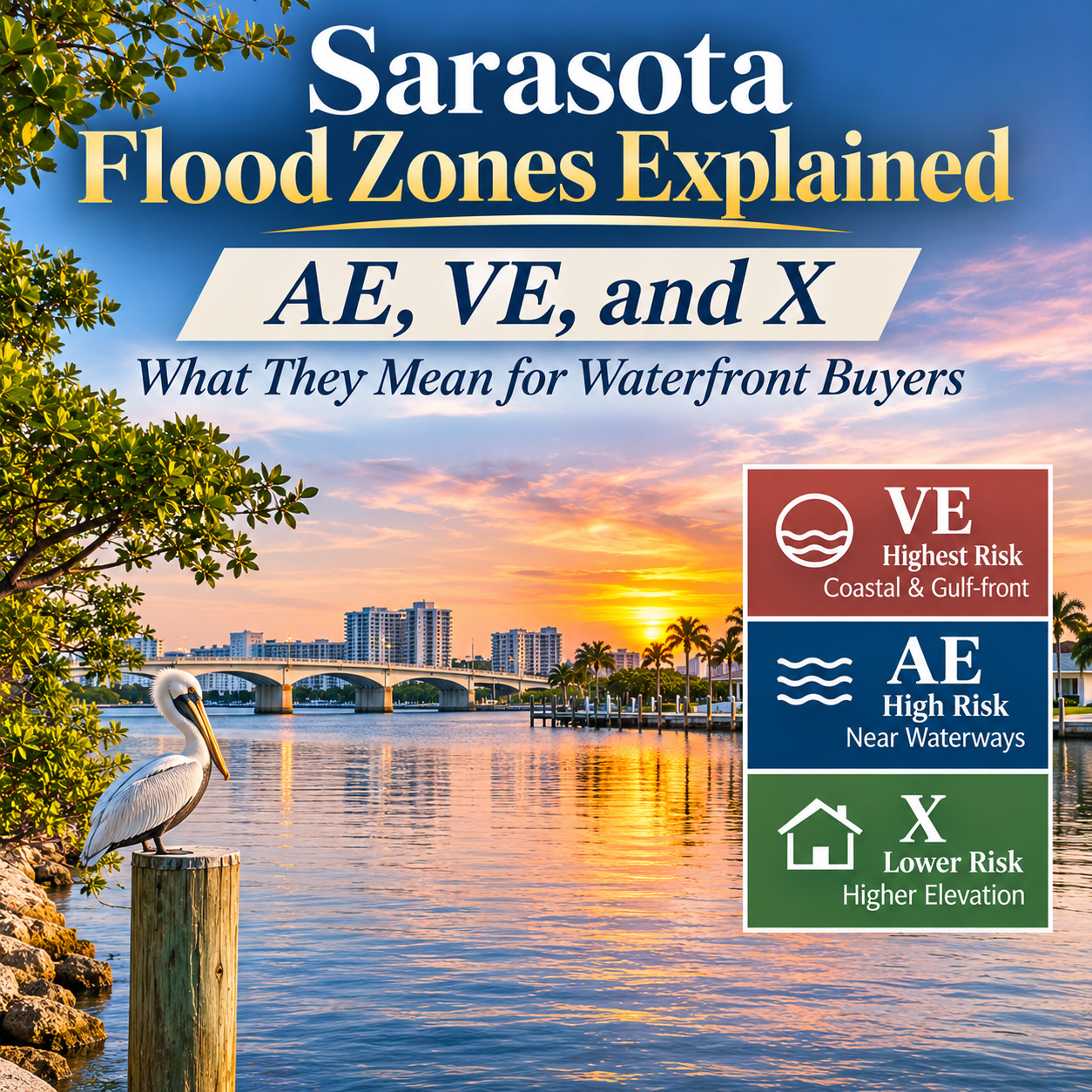
Flood Zone AE identifies areas within FEMA's mapped 1% annual-chance floodplain, often referred to as the Special Flood Hazard Area.
A 1% annual chance means that a flood of that magnitude has a 1% probability of occurring or being exceeded in any given year.
It does not mean a property will flood only once every 100 years.
What makes Zone AE different?
Zone AE generally includes mapped base flood elevations.
A base flood elevation, or BFE, represents the calculated elevation that floodwaters are expected to reach during the 1% annual-chance flood event.
For example, if a property has a mapped BFE of 10 feet NAVD88, that elevation refers to a specific vertical datum used for surveying and mapping.
It does not mean the home will experience exactly 10 feet of water.
The home's finished-floor elevation and the surrounding ground elevations must be considered relative to the mapped flood elevation.
Does Zone AE require flood insurance?
For buildings in a Special Flood Hazard Area with mortgages from federally regulated or insured lenders, flood insurance is generally required.
However, the specific requirement depends on the loan, building, and applicable rules.
Cash buyers may not face the same lender requirement, but that does not eliminate flood exposure.
My recommendation: Don't evaluate an AE-zone property solely by its flood designation. Investigate the home's actual elevation, construction characteristics, flood history, and insurance options.
3. Flood Zone VE: What Does It Mean?
Zone VE is a coastal high-hazard flood zone.
Like Zone AE, it is within the mapped 1% annual-chance floodplain.
However, VE zones also account for additional coastal hazards, particularly high-velocity wave action.
These areas may experience conditions that create different structural demands than those found in many inland flood zones.
Why is Zone VE important?
Coastal high-hazard areas can have stricter construction requirements.
For example, new or substantially improved buildings in designated coastal high-hazard areas may be required to use elevated foundation systems that allow floodwaters and waves to pass beneath the structure.
Specific requirements depend on applicable building codes, floodplain regulations, and the nature of the project.
Is a VE-zone property automatically a bad investment?
No.
Some highly desirable coastal properties are located within VE zones.
A property's market appeal, construction quality, elevation, insurance costs, and overall condition all contribute to the purchasing decision.
The important consideration is whether the buyer understands the risks and associated financial responsibilities.
4. Flood Zone X: Does That Mean You're Safe From Flooding?
This is one of the most misunderstood flood zone classifications.
Zone X generally identifies areas outside FEMA's mapped Special Flood Hazard Area.
However, not all Zone X designations represent the same mapped level of risk.
Shaded Zone X
Shaded Zone X generally represents areas of moderate flood hazard, including portions of the 0.2% annual-chance floodplain.
Unshaded Zone X
Unshaded Zone X generally represents areas of minimal mapped flood hazard.
Neither designation means flooding is impossible.
A property in Zone X may still experience flooding from intense rainfall, drainage problems, or events beyond the mapped flood scenario.
Is flood insurance required in Zone X?
Flood insurance is generally not required under the federal mandatory purchase rule for properties located entirely outside Special Flood Hazard Areas.
However, individual lenders may impose additional requirements.
Homeowners can also choose to purchase flood insurance voluntarily.
A Zone X designation should never be interpreted as a promise that a home will remain dry.
5. Sarasota Flood Zones at a Glance
| Flood zone | General classification | Key consideration |
|---|---|---|
| AE | High-risk floodplain | Base flood elevations are generally provided |
| VE | Coastal high-hazard area | Wave action and coastal construction requirements |
| Shaded X | Moderate mapped flood hazard | Often includes 0.2% annual-chance flood areas |
| Unshaded X | Minimal mapped flood hazard | Flooding remains possible |
These are simplified descriptions. Other FEMA flood zones and special designations also exist.
6. Why Two Homes in the Same Neighborhood Can Have Different Flood Risks
Imagine two waterfront homes in the same Sarasota neighborhood.
Both overlook a canal.
Both are approximately the same distance from Sarasota Bay.
One is an older ground-level residence.
The other is a newer elevated home designed with its lowest floor above the applicable flood elevation.
Even if both properties share the same FEMA flood zone, their building elevations and construction characteristics may create very different flood exposure.
Other factors can include:
- Ground elevation
- Finished-floor elevation
- Building foundation type
- Location of mechanical equipment
- Enclosures below elevated floors
- Flood openings
- Previous flood damage
- Drainage conditions
This is why I encourage buyers to evaluate the actual structure, not simply the colored flood map.
7. What Is an Elevation Certificate?
An elevation certificate is a document that records important elevation information about a building.
It may include the building's location, flood zone information, and surveyed elevations relevant to floodplain management.
Elevation certificates are commonly prepared by qualified surveying or engineering professionals.
Why should buyers ask for one?
An elevation certificate can help clarify how the building sits relative to mapped flood elevations.
It may also be useful for insurance purposes, floodplain compliance, or evaluating proposed improvements.
However, not every property has an existing elevation certificate.
And an elevation certificate does not guarantee that a building will avoid flood damage.
For waterfront buyers, obtaining available elevation documentation is an important part of due diligence.
8. Sarasota County's Flood Maps Changed in 2024
Sarasota County's updated FEMA Flood Insurance Rate Maps became effective on March 27, 2024.
These maps replaced the previous effective mapping for affected areas.
Some properties experienced changes in mapped flood zones or flood elevations.
That makes it important to verify current information rather than relying on older listing descriptions or documents.
Where should buyers check?
Start with FEMA's official Flood Map Service Center and Sarasota County's floodplain information resources.
Property-specific flood determinations should use the current effective map and any applicable amendments.
If a property has been issued a Letter of Map Amendment or Letter of Map Revision, that documentation may also be relevant.
9. How Does Flood Insurance Pricing Work?
Flood insurance premiums are not determined solely by whether a property is in Zone AE, VE, or X.
The National Flood Insurance Program uses its Risk Rating 2.0 methodology to evaluate a range of flood risk characteristics.
These can include:
- Distance to flooding sources
- Flood frequency and type
- Building elevation and characteristics
- Replacement cost
- Coverage selected
- Deductibles
- Other applicable rating factors
Private flood insurance providers may use different underwriting methods.
As a result, two homes in the same mapped flood zone may receive different insurance quotes.
Should buyers compare NFIP and private flood insurance?
Yes.
Depending on the property and eligibility, both may be worth investigating.
Coverage limits, exclusions, deductibles, renewal provisions, and insurer requirements should be reviewed carefully.
A lower premium does not automatically mean a policy provides equivalent protection.
For the broader insurance picture, read my guide to Sarasota hurricane home insurance.
10. Does Flood Insurance Cover Everything?
No.
Flood insurance has coverage limits, exclusions, and policy-specific conditions.
For example, the standard National Flood Insurance Program policy generally excludes certain outdoor improvements and structures.
These can include:
- Seawalls
- Docks and piers
- Swimming pools
- Landscaping
- Certain detached structures and property outside the insured building
Coverage for basements and enclosed areas below elevated buildings may also be limited.
Waterfront buyers should carefully review what is and isn't insured.
A property with expensive marine improvements may require additional financial planning for losses that standard flood insurance does not cover.
11. How Can Flood Zones Affect Renovations?
This is particularly important for buyers purchasing older waterfront homes with plans for major renovations.
Properties located within regulated flood hazard areas may be subject to substantial improvement and substantial damage rules.
Under the National Flood Insurance Program's minimum standards, a substantial improvement generally involves work costing at least 50% of the building's market value before the improvement, subject to applicable definitions and exclusions.
When that threshold is reached, the building may need to meet current floodplain construction requirements.
Local regulations may be more restrictive.
Why this matters
Imagine purchasing an older waterfront home with plans for an extensive renovation.
You may intend to replace the kitchen, bathrooms, flooring, windows, and mechanical systems.
If the proposed work triggers substantial improvement requirements, additional compliance measures could significantly affect the project.
This is why buyers considering major renovations should consult the applicable local floodplain administrator and qualified design professionals before purchasing.
12. What About Homes That Have Flooded Before?
A property's flood history is an important consideration.
Buyers should investigate known previous flooding, repairs, insurance claims where available, and any relevant seller disclosures.
In Florida, residential sellers generally have a duty to disclose known facts materially affecting property value that are not readily observable and are not known to the buyer.
Florida also has specific statutory flood disclosure requirements for residential real property transactions.
These requirements address certain known flooding and flood-related information.
Buyers should review the applicable disclosures and independently investigate concerns. I cover the seller side in more detail in Florida's 2026 flood disclosure rules.
Previous flooding does not automatically mean a property should be avoided.
But the nature of the event, the extent of damage, and the quality of repairs deserve careful evaluation.
13. Do Flood Zones Affect Sarasota Property Values?
They can, but there is no universal price adjustment for a particular flood zone.
Buyers may consider insurance expenses, perceived risk, construction limitations, and future resale concerns.
However, waterfront properties also offer location and lifestyle characteristics that may support strong demand.
A highly desirable bayfront property may remain valuable despite elevated flood exposure.
Conversely, a property with significant flood-related limitations may face a narrower buyer pool.
A reliable valuation should consider relevant comparable sales, building characteristics, and current market conditions.
Flood zone classification is one part of the analysis, not the entire answer.
14. What I Recommend Checking Before Buying a Sarasota Home
Whether you're purchasing waterfront property or an inland home, I recommend investigating the following:
- Verify the current FEMA flood zone.
- Review the mapped base flood elevation, if applicable.
- Request an available elevation certificate.
- Obtain property-specific flood insurance quotes.
- Review homeowners insurance coverage and exclusions.
- Ask about known previous flooding.
- Review applicable seller flood disclosures.
- Investigate flood-related repairs and permits.
- Consider drainage and surrounding elevations.
- Review renovation plans for potential floodplain compliance issues.
- Confirm lender insurance requirements.
- Consult qualified professionals when questions remain.
A little additional investigation before purchasing can prevent significant surprises later. For the complete walkthrough, see my waterfront home inspection checklist and what it really costs to own a waterfront home in Sarasota.
Frequently Asked Questions About Sarasota Flood Zones
Q: Is Flood Zone AE bad in Sarasota?
A: Zone AE indicates a mapped high-risk flood area, but it does not automatically make a property undesirable. Elevation, construction, insurance costs, and other property-specific characteristics should be evaluated.
Q: Is Zone X the best flood zone?
A: Unshaded Zone X generally indicates minimal mapped flood hazard, but it does not mean a property is free from flooding risk.
Q: What is the difference between AE and VE flood zones?
A: Both are within FEMA's Special Flood Hazard Area. VE also identifies coastal high-hazard conditions involving wave action, which can result in different construction requirements.
Q: Can you buy a Sarasota waterfront home without flood insurance?
A: Depending on the property and financing, flood insurance may not be mandatory. However, purchasing without flood coverage can leave the owner financially exposed to flood losses.
Q: Does an elevation certificate lower flood insurance premiums?
A: It may help provide information relevant to insurance rating, but it does not guarantee a lower premium.
Q: Can a home be in Flood Zone X and still flood?
A: Yes. Heavy rainfall, drainage problems, and flooding beyond mapped scenarios can affect properties outside Special Flood Hazard Areas.
Q: How do I find the flood zone for a Sarasota address?
A: Use FEMA's Flood Map Service Center and verify the current effective mapping. Sarasota County also provides floodplain information resources.
Understanding Flood Risk Is Part of Buying Smart in Sarasota
Sarasota's coastal environment is one of the reasons people love living here.
The bays, beaches, canals, and natural waterways create an exceptional lifestyle.
But understanding flood exposure is an important part of responsible homeownership.
A flood zone should not be viewed as the sole deciding factor in a real estate purchase.
Instead, it should prompt better questions about elevation, construction, insurance, property history, and long-term costs.
I'm Kelly Fullick, a Sarasota Realtor serving Sarasota and Manatee counties.
Whether you're considering a waterfront estate, a canal-front home, or an inland Sarasota property, I'd welcome the opportunity to help you evaluate the information that matters before making a purchase. You can also browse Sarasota homes currently on the market.
Kelly Fullick | Sarasota Real Estate
941.260.7770
Kelly@KellyFullick.com
www.KellyFullick.com
This article provides general real estate education and is not a flood risk determination, insurance recommendation, engineering opinion, or legal assessment. Property-specific information should be verified with FEMA, the applicable local floodplain administrator, insurance professionals, and qualified inspectors.
About Kelly Fullick
Kelly Fullick is a Sarasota-native Realtor with Coldwell Banker Realty. She specializes in helping out-of-state relocation buyers and Sarasota-area sellers with candid, education-first guidance. Kelly has closed 36+ transactions totaling over $18.6M across Sarasota and Manatee County since 2022, and holds a perfect 5.0-star rating on 25 Google reviews.

Ready to take the next step?
Let's Talk About Your Goals
Every situation is different. Schedule a no-pressure conversation with Kelly to get clear on your options.
941.260.7770
kelly@kellyfullick.com
Schedule a Consultation