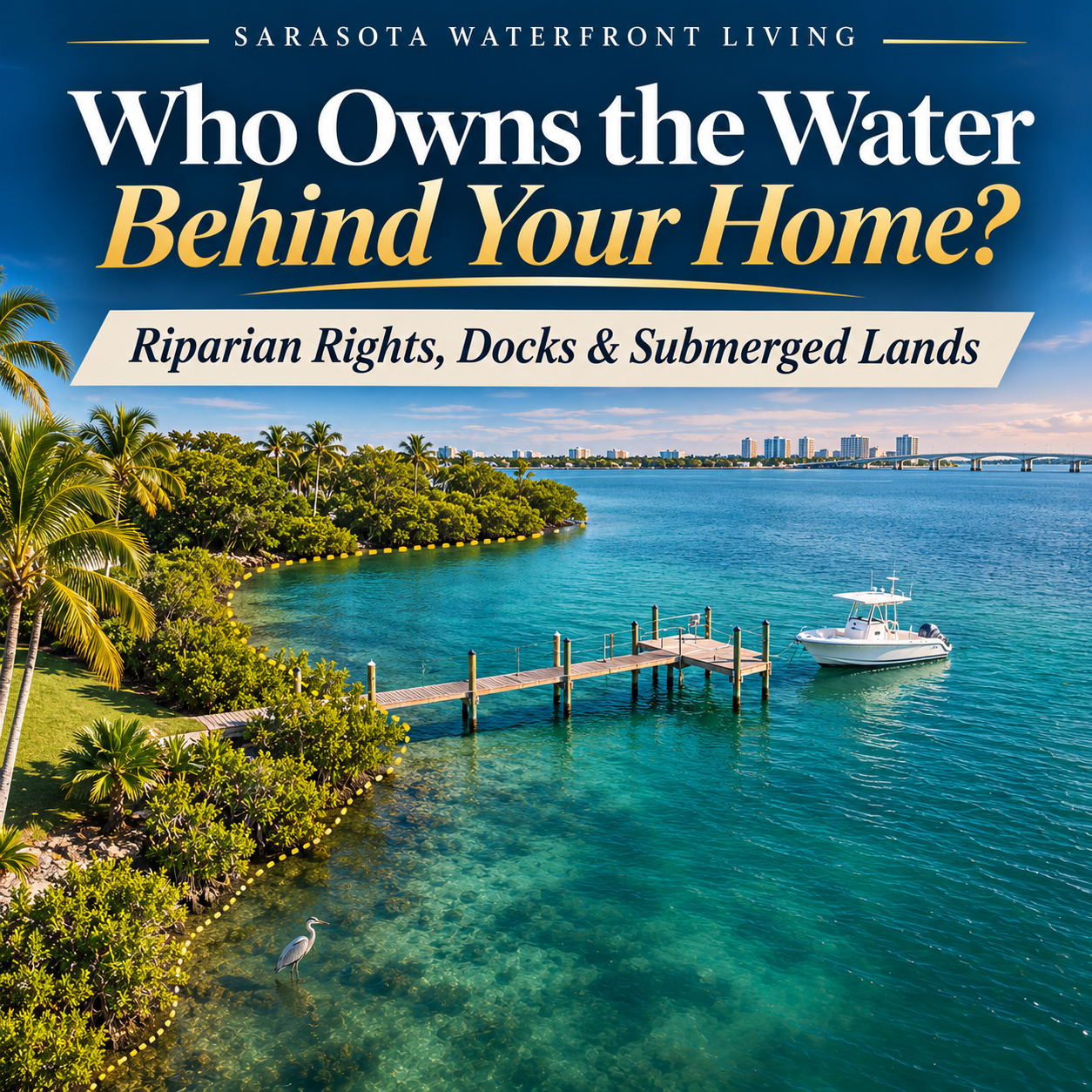
Who Owns the Water Behind Your Sarasota Home? Riparian Rights, Docks, and Submerged Lands Explained
Owning a waterfront lot in Florida does not mean owning the water or the land beneath it. Here is what riparian rights actually cover, where your boundary really ends, and what to verify before buying.
Who Owns the Water Behind Your Sarasota Home? Riparian Rights, Docks, and Submerged Lands Explained
Imagine purchasing a beautiful waterfront home in Sarasota.
Your backyard overlooks a peaceful canal. There's a seawall along the property, a private dock extending into the water, and plenty of room for the boat you've been dreaming about.
Naturally, you assume the water directly behind your property belongs to you.
But does it?
In Florida, owning waterfront property does not automatically mean you own the water or the land beneath it.
And perhaps more surprisingly, owning a waterfront lot doesn't necessarily mean you have unrestricted permission to build a dock, expand your seawall, dredge the canal, or install a larger boat lift.
These distinctions matter tremendously when buying waterfront real estate in Sarasota.
Whether you're considering a property on Bird Key, Longboat Key, Siesta Key, or along one of Sarasota's residential canals, understanding waterfront property rights can help you avoid expensive assumptions.
Let's explore what Florida waterfront owners actually own, what riparian rights mean, and why submerged land ownership matters.
1. When You Buy a Waterfront Home, Do You Own the Water?
Generally speaking, no.
In Florida, many navigable waterways and the lands beneath them are held by the state in trust for the public.
These are known as sovereignty submerged lands.
They can include lands beneath tidal waters, bays, navigable rivers, and other qualifying waterways.
For example, owning a bayfront property along Sarasota Bay does not automatically give you private ownership of the bay bottom extending outward from your shoreline.
The state may own the submerged land, while the waterfront homeowner holds certain legally recognized rights associated with the adjoining upland property.
However, there are exceptions.
Some submerged lands have been conveyed into private ownership, and certain artificially created waterways have different ownership histories.
This is why the legal status of a particular canal or submerged parcel should be verified rather than assumed.
2. What Are Riparian Rights in Florida?
Riparian rights are legal rights associated with qualifying land bordering navigable waters.
Florida Statute 253.141 identifies rights that include access to and from the water, boating, bathing, and fishing, along with other rights recognized by law.
These rights are connected to the waterfront property itself.
They generally transfer with the qualifying land when ownership changes.
What does that mean for a Sarasota homeowner?
Depending on the circumstances, riparian rights may allow a qualifying waterfront owner to access adjacent navigable water and pursue appropriately authorized docking facilities.
However, those rights are not unlimited.
They are subject to public rights, environmental regulations, navigation requirements, and the rights of neighboring waterfront owners.
A critical distinction is that riparian rights are not the same as ownership of the submerged land.
You may have a legally protected right to access navigable water without owning the land beneath that water.
3. What Is the Difference Between Riparian and Littoral Rights?
You may hear both terms used when discussing waterfront real estate.
Traditionally, riparian rights are associated with property bordering rivers and streams, while littoral rights are associated with property bordering oceans, seas, and lakes.
In Florida, the terminology can overlap in legal discussions, and statutes and court decisions frequently use riparian rights when addressing navigable waterfront property more broadly.
For a Sarasota buyer, the important issue isn't simply which term appears in a conversation.
It's determining which rights legally attach to the specific property.
Those rights can influence access, dock construction, waterfront use, and disputes involving neighboring properties.
4. Where Does Your Waterfront Property Actually End?
This is where waterfront property ownership becomes particularly interesting.
Many buyers assume their property boundary ends at the seawall.
But the legal shoreline boundary is not necessarily identical to the physical location of a seawall, dock, fence, or landscaped edge.
For tidal waters, the mean high water line is often relevant in determining the boundary between privately owned uplands and sovereignty submerged lands.
For qualifying navigable freshwater bodies, the ordinary high water line may apply.
These boundaries can involve technical surveying and legal questions.
Why a survey matters
A professional boundary survey can help identify the property's recorded boundaries and relevant physical features.
However, not every standard residential survey establishes the legally controlling shoreline boundary.
Waterfront parcels may require specialized surveying, title research, or legal analysis.
Before purchasing, ask whether the existing survey adequately addresses the waterfront boundary and any improvements extending beyond it.
5. Can Someone Else Own the Land Between Your House and the Water?
Yes.
This is an important possibility that buyers may overlook.
A home may have an unobstructed water view without the owner's property extending all the way to the shoreline.
In some situations, a narrow strip of land, public right-of-way, conservation area, or other separately owned parcel lies between the residence and the water.
That can affect whether riparian rights attach to the property.
Florida law generally requires qualifying ownership extending to the applicable shoreline boundary for riparian rights to attach.
Why this matters
Imagine purchasing a home marketed as waterfront with plans to build a dock.
After closing, you discover that a narrow strip of land separating your parcel from the shoreline is owned by another party.
That could substantially complicate or prevent your proposed dock project.
Before buying, investigate the legal description, title commitment, survey, and any recorded easements or rights-of-way.
A water view and legal waterfront ownership are not necessarily the same thing.
6. Does Owning Riparian Rights Mean You Can Build a Dock?
Not automatically.
Florida recognizes qualified rights associated with accessing navigable waters, including certain rights related to docking structures.
But those rights must be exercised consistently with applicable laws and regulations.
Dock construction may involve:
- Local building or marine construction permits
- Florida environmental resource permitting
- Authorization to use sovereignty submerged lands
- Federal review or authorization
- Environmental protection requirements
- Navigation restrictions
- Neighboring riparian rights
- HOA or deed restrictions
The applicable approvals depend on the project and location.
Even if a proposed dock qualifies for an exemption from one regulatory permit, other authorizations may still be necessary.
What if neighboring homes already have docks?
That does not guarantee you can build an identical dock.
Neighboring properties may have different shoreline dimensions, water depths, submerged land conditions, environmental constraints, or previously authorized structures.
A neighboring dock may also have been constructed under different rules or permits.
Never base a waterfront purchase on the assumption that anything your neighbor has built will automatically be approved on your property.
7. What Are Sovereignty Submerged Lands?
Sovereignty submerged lands are lands beneath certain waters that the State of Florida holds in trust for the public.
Florida's public trust principles recognize public interests in navigable waters and the lands beneath them.
These interests can involve navigation, fishing, recreation, and other lawful public uses.
The Florida Department of Environmental Protection helps administer the state's submerged lands program.
Depending on the proposed activity, a waterfront owner may need proprietary authorization to use state-owned submerged lands.
Regulatory approval versus proprietary authorization
These are two different concepts.
Regulatory approval addresses whether an activity complies with applicable environmental and construction requirements.
Proprietary authorization addresses permission to use land owned by the state.
A project may require one or both.
This distinction becomes important when constructing docks, expanding marine facilities, or undertaking certain shoreline improvements.
8. Can You Extend Your Dock Farther Into the Canal?
Possibly, but the answer depends on the specific property and proposed design.
Extending a dock may affect navigation, neighboring access, environmental resources, and the use of submerged lands.
The fact that your existing dock is legally permitted does not necessarily mean you can extend it indefinitely.
A proposed expansion may require updated permits and additional review.
What should buyers investigate?
Before purchasing a property with plans for a larger dock, determine:
- The current dock's permitted dimensions
- The proposed extension length
- Water depth along the proposed structure
- Available navigation clearance
- Environmental conditions
- Potential interference with neighboring waterfront rights
- Applicable government approvals
- Private neighborhood restrictions
A qualified marine contractor and the relevant permitting agencies can help evaluate feasibility.
9. Can You Dredge the Canal Behind Your Home?
This is another common waterfront misconception.
Suppose you purchase a beautiful canal-front property, but the water is too shallow for your boat.
You might assume you can simply hire a contractor to deepen the canal.
Unfortunately, dredging is not that straightforward.
Dredging can disturb bottom sediments, affect water quality, alter aquatic habitats, and involve state-owned submerged lands.
Depending on the project, approvals may be required from local, state, and federal authorities.
Environmental restrictions may also limit whether dredging can occur.
Why this matters to boat owners
If a canal is too shallow for your vessel, don't purchase the property assuming dredging will solve the problem.
First determine whether dredging is legally and practically feasible.
The cost, permitting timeline, and environmental requirements may make the project impractical.
In some situations, approval may not be available.
10. Can You Move Your Seawall to Create More Backyard?
Imagine purchasing a waterfront home with a relatively small backyard.
You begin considering whether the seawall could be moved several feet into the canal to create additional usable land.
This is not simply a landscaping project.
Moving a seawall waterward may involve filling submerged lands, altering the shoreline, and affecting public or neighboring interests.
Such activities are regulated and may be prohibited or severely restricted depending on the circumstances.
Some narrowly defined shoreline restoration projects qualify for particular exemptions, but those provisions should not be confused with general permission to expand private waterfront land.
Before purchasing with the intention of reclaiming additional land, obtain appropriate professional and regulatory guidance.
11. What Happens When Two Waterfront Neighbors Disagree About Dock Placement?
Waterfront property disputes can involve more than traditional property lines.
For example, two neighboring owners may disagree about where a dock should extend or whether a proposed lift interferes with access.
These disputes can involve riparian rights, navigation, shoreline geometry, and applicable regulations.
The legal analysis is not always as simple as extending the upland property lines straight into the water.
The appropriate allocation of waterfront access may depend on the shape of the shoreline, established rights, and the specific circumstances.
A surveyor experienced with waterfront boundaries and a Florida real estate attorney may be needed.
Buyers should investigate existing disputes or unusual dock configurations before purchasing.
12. Can You Own the Bottom of a Private Canal?
In some circumstances, yes.
Not every Florida canal has the same legal ownership structure.
Certain artificially created canals and other waterways may involve privately owned submerged lands.
Ownership can depend on the original land conveyances, plats, reservations, and subsequent transactions.
However, private ownership of submerged land does not necessarily eliminate environmental regulations, navigation rights, or other applicable legal restrictions.
What should buyers request?
For properties with unusual waterfront arrangements, consider reviewing:
- The recorded plat
- The legal description
- The title commitment
- Relevant easements
- Submerged land ownership records
- Existing dock and seawall permits
- Association documents
- Applicable state land authorizations
A qualified attorney can help determine whether additional title investigation is appropriate.
13. Does Having Riparian Rights Increase Property Value?
Riparian rights can be an important component of waterfront property value.
Buyers may place substantial value on the ability to access navigable water, maintain a dock, or enjoy boating from their own property.
However, those rights are not identical for every waterfront parcel.
The practical benefits may depend on water depth, navigability, environmental restrictions, dock feasibility, and the physical characteristics of the shoreline.
A property with an established, properly authorized dock and suitable boating access may appeal to a different buyer pool than a property with a water view but uncertain docking rights.
Why this matters when comparing homes
Imagine two homes overlooking the same canal.
One has documented waterfront ownership, a permitted dock, and navigable access suitable for the buyer's boat.
The other has a beautiful water view but a separate strip of land between the property and shoreline.
These properties may offer very different legal rights and practical uses.
Those differences should be considered when evaluating comparable sales and market value.
14. What I Recommend Checking Before Buying Waterfront Property in Sarasota
Before purchasing, especially if you intend to build or modify marine structures, consider the following checklist.
- Confirm that the parcel legally extends to the relevant shoreline boundary.
- Review the legal description and recorded plat.
- Obtain an appropriate boundary survey.
- Investigate any easements or rights-of-way.
- Determine whether riparian rights attach to the property.
- Review existing dock and seawall permits.
- Confirm whether submerged lands are state-owned or privately owned.
- Investigate required state land authorizations.
- Verify dock or lift expansion feasibility.
- Review applicable HOA restrictions.
- Investigate known waterfront boundary disputes.
- Consult a qualified Florida real estate attorney when ownership or access questions are unclear.
The goal isn't to make waterfront purchasing unnecessarily complicated.
It's to understand the property rights that make the waterfront lifestyle possible.
For the physical side of the same due diligence, read my guides to what to inspect before buying a waterfront home, seawall repair and replacement costs, and boat lift installation and permits.
Frequently Asked Questions About Florida Waterfront Property Rights
Q: Do I own the water behind my Sarasota waterfront home?
A: Generally, no. Many navigable waterways and submerged lands are held by the state for the public, although private submerged land ownership exists in some circumstances.
Q: What are riparian rights in Florida?
A: Riparian rights are legal rights associated with qualifying property bordering navigable water. They can include access, boating, fishing, and other rights recognized by Florida law.
Q: Can I build a dock if my property touches the water?
A: Possibly. Dock construction depends on applicable property rights, permitting requirements, environmental conditions, and other restrictions.
Q: Can my neighbor build a dock in front of my property?
A: Dock placement must comply with applicable laws and cannot unreasonably interfere with protected neighboring riparian rights. Disputes may require surveying, regulatory review, or legal analysis.
Q: Can I dredge a canal to accommodate a larger boat?
A: Dredging may require multiple approvals and can be restricted by environmental conditions. Feasibility should be confirmed before purchasing.
Q: Does a seawall establish my legal property boundary?
A: Not necessarily. The legal boundary may depend on surveys, deeds, shoreline conditions, and applicable Florida law.
Q: Do riparian rights transfer when I sell my waterfront home?
A: Qualifying riparian rights generally transfer with the associated waterfront land, subject to applicable law and the property's legal circumstances.
Waterfront Ownership Is About More Than the View
One of the most appealing aspects of living in Sarasota is the connection to the water.
Whether you're watching dolphins in Sarasota Bay, keeping your boat behind your home, or enjoying the peaceful setting of a residential canal, waterfront property can offer an extraordinary lifestyle.
But understanding what you legally own is just as important as understanding the physical property.
A beautiful view doesn't automatically establish dock rights.
An existing seawall doesn't necessarily identify the legal boundary.
And a private dock doesn't mean the owner has unrestricted control over the water surrounding it.
The best waterfront purchase is one where the lifestyle, property condition, and legal rights all align with your expectations.
I'm Kelly Fullick, a Sarasota Realtor serving Sarasota and Manatee counties.
If you're considering buying or selling waterfront property, I'd welcome the opportunity to help you evaluate the property information, identify important due diligence questions, and connect you with qualified professionals when specialized expertise is needed. You can also browse Sarasota waterfront homes currently on the market.
Kelly Fullick | Sarasota Real Estate
941.260.7770
Kelly@KellyFullick.com
www.KellyFullick.com
This article provides general educational information and does not constitute legal advice, a title opinion, or a determination of waterfront property rights. Specific ownership, boundary, submerged land, and permitting questions should be reviewed by qualified Florida professionals and the relevant government agencies.
About Kelly Fullick
Kelly Fullick is a Sarasota-native Realtor with Coldwell Banker Realty. She specializes in helping out-of-state relocation buyers and Sarasota-area sellers with candid, education-first guidance. Kelly has closed 36+ transactions totaling over $18.6M across Sarasota and Manatee County since 2022, and holds a perfect 5.0-star rating on 25 Google reviews.

Ready to take the next step?
Let's Talk About Your Goals
Every situation is different. Schedule a no-pressure conversation with Kelly to get clear on your options.
941.260.7770
kelly@kellyfullick.com
Schedule a Consultation